

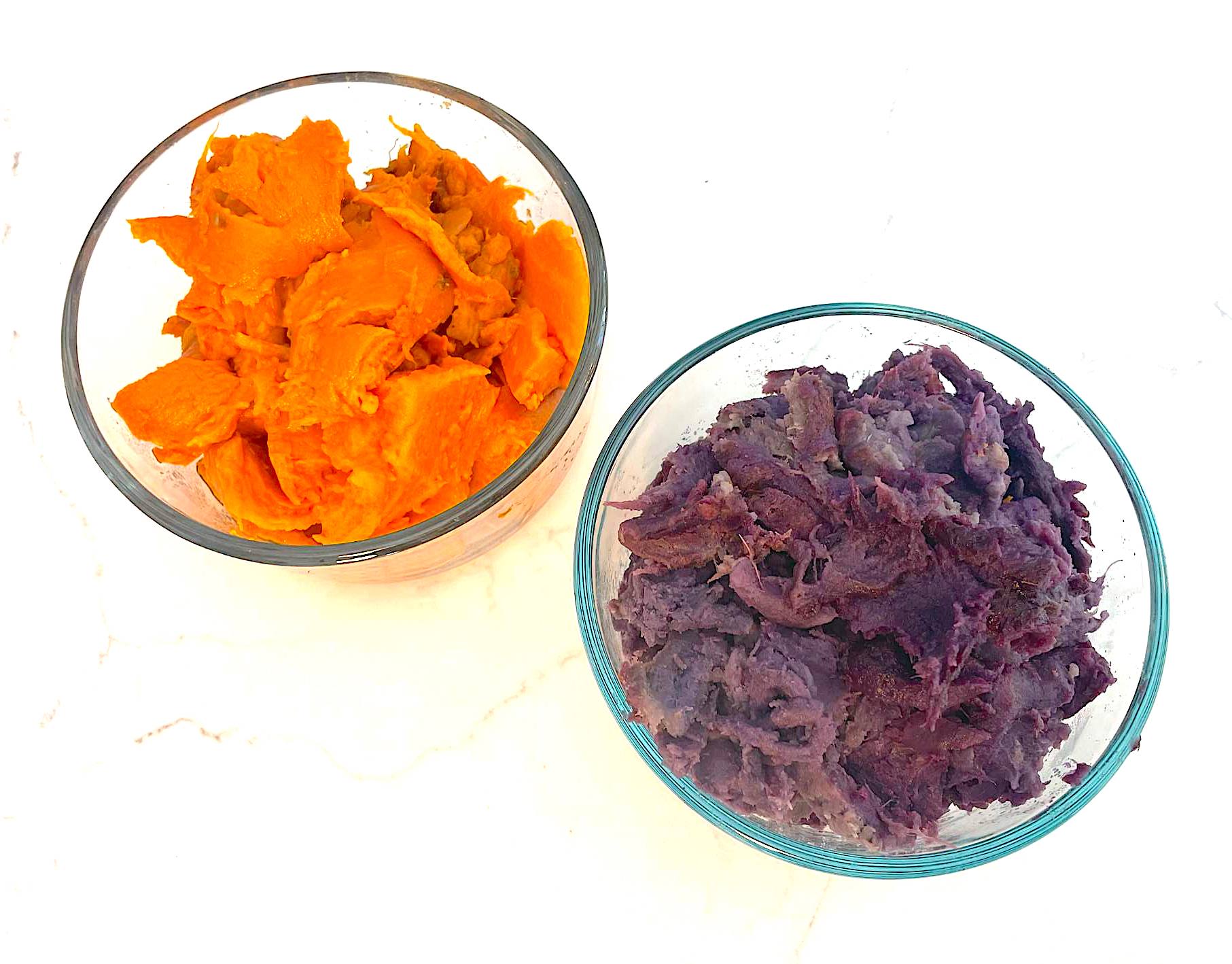
When recipes call for cooked sweet potato or yams, baking them is the way to go. Here’s an easy way to prepare sweet potatoes and/ or yams to use in all kinds of recipes whether you’re making pancakes, cakes, muffins or simply want to add some sweet root vegetable goodness to your smoothie.
A ROOT VEGETABLE STAPLE
Sweet potatoes and yams are wonderful flavor boosters and nutrient enhancers in whole food plant-based cooking. They can also help improve texture. I like to bake up batches of yams and sweet potatoes as soon as I bring them home. Compared to other root vegetables like potatoes and beets, uncooked sweet potatoes and yams can go bad pretty quickly when stored raw in the fridge. This is especially true if you’re buying organic. When they’re cooked and stored in a sealed container, they stay fresh for at least a week and I’ll have them on hand for an easy healthy snack or to use in recipes.
SLOWISH BAKING TEMPERATURE
There’s no single perfect temperature for baking sweet potatoes and yams. The right temperature depends on what you want to use them for and how much oven time you’re willing to devote to the process. When my goal is to have mushy flesh to use in smoothies and baking, I like to bake my yams and sweet potatoes at 350 °F (about 175 °C) because this temperature allows me to get the most flesh possible that’s easy to pull away from the skin. Depending on the size and type of sweet potato being cooked, this temperature takes one to one and a half hours. That’s not a crazy long amount of time and I get great results. Higher temperatures are faster and also work, but the flesh will not be cooked as evenly.
EASY PREP
To prepare sweet potatoes and yams for baking just wash them and place them on a baking sheet that’s lined with parchment paper or aluminum foil. Lining the baking sheet is important because sweet potatoes and yams ooze a dark sticky caramel like substance during the baking process resulting in a cleanup nightmare that should be avoided.


CHECKING FOR DONENESS
When baking different types or sizes of sweet potatoes and yams in the same tray, set the timer for one hour and check for doneness at that point. Wearing an oven mitt to keep from getting burnt, squeeze each sweet potato or yam to see if they are squishy enough to pull out of the oven. The ones that are squishy get pulled out and set aside. Put any sweet potatoes or yams that are not soft yet back in the oven for another 15 minutes. Check again, pull out the squishy ones and, if necessary, go for another fifteen minute interval for the ones that are still not cooked.
To illustrate this process I chose to bake two garnet yams along with two purple sweet potatoes. The smaller garnet yam was done after one hour. The large garnet yam was done after an hour and fifteen minutes. And the purple sweet potatoes both took an hour and a half to become soft and squishy.


SCOOPING OUT THE FLESH
After sweet potatoes and/or yams are done and out of the oven, let them cool at least a little before scooping them out. Alternatively, they can be stored unpeeled in a sealed container for up to five days and you can scoop them out later as needed.
To scoop out the flesh, slice them lengthwise and use a spoon to gently remove the flesh. If they have been cooked sufficiently, it should be easy to pull the flesh away from the skin.


USE OR STORE FOR LATER
Use sweet potato flesh immediately or store in the fridge in a sealed container for up to five days. Freezing is another great option.
recipes with roasted sweet potatoes


Baking Sweet Potatoes and Yams to Use in Recipes

Equipment
- Baking Sheet
- Parchment Paper or Aluminum Foil
Ingredients
- 1 to 8 Sweet Potatoes or Yams, washed (or as many as fit on your baking sheet with at least an inch between them)
Instructions
- Preheat oven to 350 ℉ (or approximately 175 ℃)
- Line baking sheet with parchment paper or aluminum foil
- Place sweet potatoes and/or yams on lined baking sheet. If baking a large batch at a time, make suer there's at least 1 inch (2.5 cm) of space between them so that the heat can circulate.
- Bake in 350 ℉ (or approximately 175 ℃) for one hour and check for doneness by putting on an oven mitt and squeezing them. When they are done they should be soft and squishy. Yams usually cook more quickly than sweet potatoes. Smaller yams and sweet potatoes cook more quickly than the large ones. If not all sweet potatoes are done, remove the ones that are and bake the rest for another 15 minutes. Check for doneness again, once again removing the ones that are done. Larger sweet potatoes may require up to about 1½ hours of cooking time.
- Cool cooked sweet potatoes before removing flesh so that they are easy to handle. Alternately, you can refrigerate them for up to five days in a sealed container before removing flesh.
- To remove flesh, slice sweet potatoes (or yams) lengthwise and gently scoop out the flesh with a spoon, pulling it away from the peel.
- Use immediately or store in the fridge in a sealed container for up to 5 days. Another option is to place sealed container in the freezer where they will keep for about one year.


Leave a Reply