

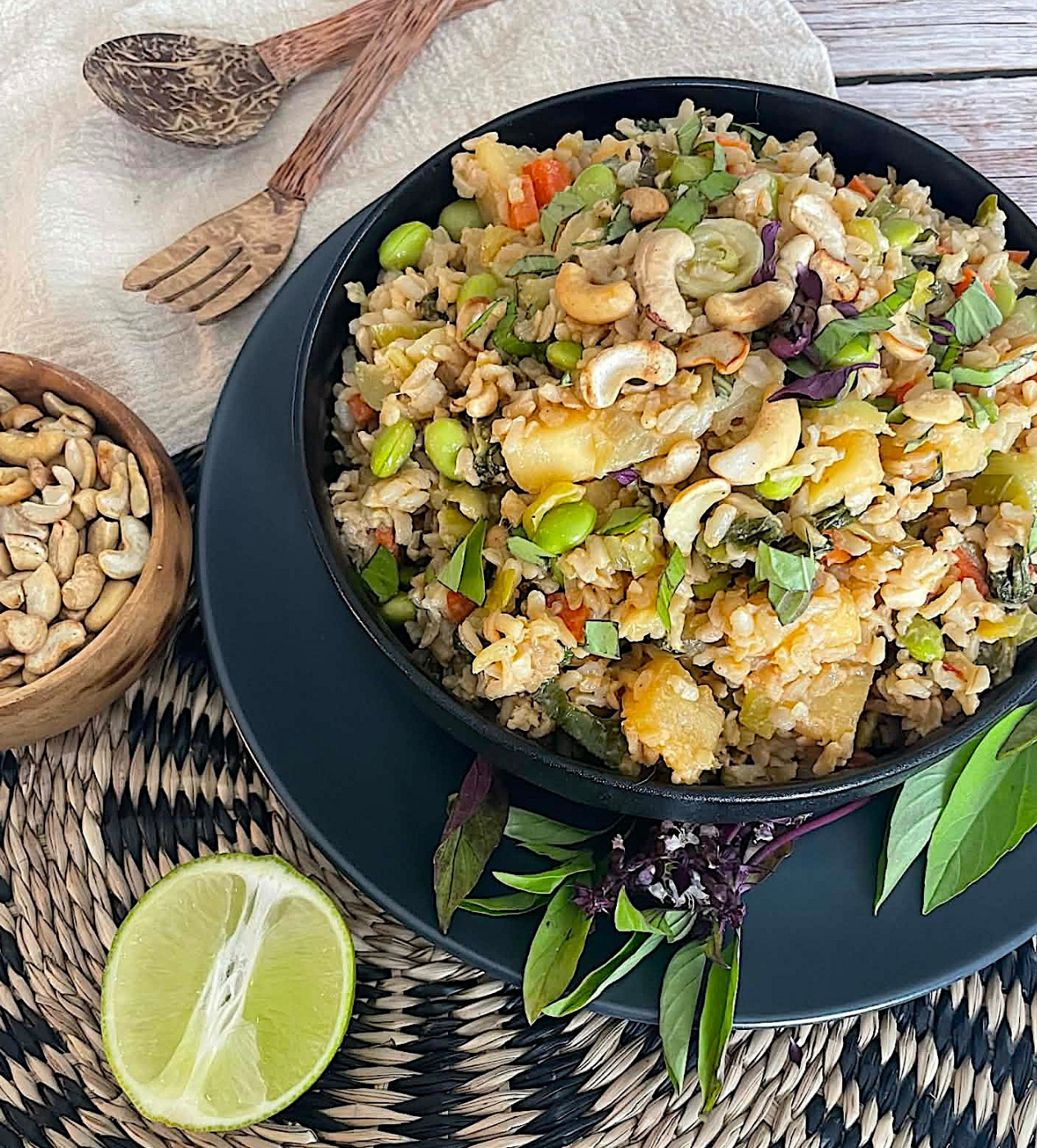
This vibrantly juicy vegan main course was inspired by the sweet and savory flavors of Thai pineapple fried rice. Brown rice, bok choy and edamame make this rice dish a nutritional powerhouse. Layers of healthy plant-powered goodness are seasoned with a blend of hoisin and sriracha sauces and topped with toasted cashew pieces.

WHY I LOVE IT
This pineapple rice dish is a delightfully fun and flavorful way to get optimal whole food plant-based nutrition. It’s also fairly foolproof, just a matter of prepping and lining up all the ingredients. Putting it all together is easy and you end up with a satisfying main dish that truly has it all—a whole grain, a legume, a leafy green that’s also cruciferous, a colorful vegetable, a fruit, a nut, a seed!
HEALTHY FRIED RICE ALTERNATIVE
Before becoming serious about the oil-free whole food plant-based (WFPB) lifestyle, I loved fried rice of all kinds. So when I had the idea for this recipe I thought of calling it an oil-free Thai pineapple fried rice, but then I decided that labeling it that way might set up some unrealistic, and frankly unnecessary, expectations. Being WFPB adherent almost all the time means that my tastebuds have been recalibrated such that I no longer enjoy the oiliness of traditional restaurant style fried rice the way I once did. Don’t get me wrong, eating plant-based fried rice the way most restaurants make it is still a pleasant experience. But the last time I ate pineapple fried rice at a Thai restaurant I found myself wishing that it wasn’t quite so rich and oily. I know from chatting with other WFPB folks that I’m not alone. Our preferences really do change and some WFPB meals are good precisely because they’re reminiscent of our old favorites without being perfect copycats.
WHY ‘DAY OLD’ RICE
One thing that this dish has in common with traditional fried rice recipes is that it requires slightly dried out rice. Usually that means using rice that’s at least a day old. The texture of the rice is important because a partially dehydrated shrunken rice kernel is better able to become coated by the seasoning. In this particular recipe the pineapple and bok choy are already bringing a lot of moisture, so the rice needs to be quite dry in order to pick up this moisture. Does this mean that you always need to use rice that was cooked at least 24 hours ago? No, you can recreate the texture of ‘day old’ rice in several ways and the way you cook your rice can also help achieve the right texture.
SELECT & COOK BROWN RICE
This is a whole food plant-based (WFPB) recipe which means that whole grains are preferred. But if you want to make this recipe with white rice, that’s fine. My favorite rice to use in this recipe is brown basmati rice because it’s one of the least sticky kinds of brown rice, and I like that aspect of it for this and many other recipes. You can use any leftover rice you have on hand, but if you’re making rice specifically for this recipe I recommend using the pasta method for cooking rice. The pasta method is when you cook your rice with more liquid than necessary and strain off the excess water as soon as the rice is cooked. This method makes rice less sticky because some of the starch is strained out with the excess liquid. It’s important not to overcook the rice for this recipe because mushy rice kernels would ruin the texture. If you can, I also recommend cooking the rice in vegetable broth instead of water in order to add a layer of flavor.
CREATING ‘DAY OLD’ RICE
Rice that was not overcooked will eventually become dried out enough to be good in this recipe, but there are things you can do to speed up and optimize the texture of the rice. If you’re making the rice a day ahead of time, keep it in the fridge in a container that’s covered with a clean dishtowel instead of in a sealed container. The towel will help soak up some of the excess moisture. If you want to dry out the rice that you just cooked to create a faux ‘day old rice,’ you can spread it over a cookie sheet and place it in a preheated 200 °F (approximately 95 °C) oven for 10 to 15 minutes. This method works beautifully, especially if you cooked your rice using the pasta method described in the previous section.
PINEAPPLE OPTIONS
The best fresh pineapple to use in this recipe is slightly underripe. That’s because cooking the pineapple makes it sweeter and this recipe is already quite sweet because of the hoisin and sriracha sauces. That doesn’t mean that using sweet ripe pineapple will ruin this dish. But if you have a choice, try to get pineapple that’s less juicy and sweet. Thawed frozen pineapple is fine. Just pat it dry before using it in the recipe. Canned pineapple can also be used, but it’s my least favorite option because it tends to be quite a bit sweeter than fresh or frozen. Canned pineapple should also be patted dry.
TOASTING CASHEWS
You can use store-bought roasted cashews, whole or pieces, for this recipe if you like. I usually toast my own cashews because raw cashew pieces are something I always have on hand. My favorite method for toasting cashews is to place them in a dry skillet or pan over medium heat, stirring constantly with a wooden spoon or spatula for 4 to 5 minutes until they just begin to brown. It’s important to remove the cashews from the pan immediately as soon as they’re brown because once they get golden they can burn very quickly. If you can’t have cashews due to allergies, or for any other reason, several alternatives are discussed in the substitutions section of this post.


EASY FLAVORFUL SEASONING
The seasoning for this rice consists of a combination of easy to find ingredients: hoisin sauce, sriracha sauce, tahini, soy sauce and rice vinegar. Substitutions are possible for all of these ingredients and you can scroll down to the substitutions section for my top suggestions. I love how sriracha sauce matches and enhances the tangy sweetness of the pineapple while adding a spicy kick. Hoisin sauce is wonderfully earthy sweet-savory umami seasoning that compliments many other flavors. And tahini is always one of my favorite WFPB oil substitutes especially in Mediterranean and Asian inspired dishes. If you want to learn more about why tahini is considered WFPB adherent and why it’s such a culinary treasure, I published a post about it which you can read here.


OIL-FREE SAUTÉING
Oil-free sautéing usually involves using small amounts of water or vegetable broth instead of oil to prevent sticking. The trick is to use very small amounts of liquid at a time so that you allow the food enough direct contact with the pot or skillet so that it just barely begins to brown or stick before you add a little bit of liquid to deglaze the pan and prevent full-fledged sticking. Depending on the type of pot or wok you’re using, this recipe may or may not require any broth or water at all. That’s because the pineapple, and later the bok choy, release enough liquid as they’re cooking to prevent sticking when using a sufficiently stick-proof cooking surface. I used a non-stick ceramic dutch oven to make this recipe and though I did not end up needing to add liquid during sautéing, I kept a quarter cup of vegetable broth on hand just in case. If you’re not sure that your cooking surface is sufficiently stick-proof, I strongly recommend keeping 1/4 cup of liquid nearby just in case. The chopped carrot and pineapple are sautéd for a few minutes first in order to give the carrots enough time to become tender while the pineapple slightly caramelizes. Then the bok choy, garlic, ginger are added along with the lighter portions of the green onions and sautéd until the center ribs become tender. Finally the cooked rice, edamame and seasoning sauce are added and stirred until the sauce is evenly distributed and the rice heats up. The green portions of the sliced green onions are added in last after the heat is turned off.


GLUTEN-FREE COMPATIBLE
This recipe can be adapted to gluten-free so long as the soy, hoisin and sriracha sauces being used are labeled gluten-free. While most traditional sriracha sauces don’t contain gluten, it’s still important to check labels because some do. Soy and hoisin sauce are usually not gluten-free unless they are specifically marked. I can’t speak for other parts of the world, but in the US it’s easy to find gluten-free versions of these products.
SUBSTITUTIONS
This recipe is quite flexible. When it comes to options for substituting ingredients here’s a list of ingredients with easy alternatives I would recommend.
- Cashews: Instead of toasted cashews you can top this dish with sesame seeds, toasted coconut or peanuts.
- Carrots: The carrots in this recipe act as a subtly sweet color and texture contrast. Corn kernels, chopped red pepper or winter squash would also work well.
- Edamame: Instead of shelled edamame you could use peas or chopped green beans. Keep in mind that replacing protein-packed and relatively calorie dense edamame with peas or green beans turns this dish into more of a side dish instead of a main course.
- Bok Choy: The best substitute for bok choy in this recipe would be Napa cabbage, but many other types of cabbage or leafy green vegetables would also work.
- Fresh Ginger: Instead of fresh ginger you can use the same amount of finely minced crystalized ginger or add 1/2 to 3/4 teaspoon of ground dry ginger to the seasoning mixture.
- Fresh Garlic: Instead of fresh garlic you can use one finely minced fresh shallot or add 1 to 1-1/2 teaspoons of garlic powder to the seasoning mixture.
- Tahini: Instead of tahini you can use peanut butter or cashew butter. If you are not concerned with keeping this recipe oil-free, you could also use sesame oil, or another type of culinary oil as a substitute for tahini.
- Hoisin Sauce: The best substitute for hoisin sauce is vegan oyster sauce. You can also substitute the 2 tablespoons of hoisin sauce with 4 teaspoons of additional soy sauce and 2 teaspoons of maple syrup, agave or brown sugar.
- Soy Sauce: Instead of soy sauce you can use tamari, coconut aminos or vegan Worcestershire sauce.
- Rice Vinegar: White vinegar, apple cider vinegar or white wine vinegar would work.
- Sriracha Sauce: Instead of sriracha sauce you can use any hot sauce you like. If the hot sauce you’re using isn’t sweet but you want to keep this recipe sweet-leaning, add a teaspoon of maple syrup, agave or sugar to the seasoning mixture.
- Thai Basil: Any kind of basil will work as a garnish for this dish. Fresh mint or cilantro are also great options.
related recipes you’ll love


Pineapple Rice with Bok Choy and Edamame Oil-Free WFPB

Equipment
- small bowl
- wok or cooking pot that holds at least 4.5 gallons (non-stick is an advantage but not absolutely necessary)
- wooden spoon or spatula (for sautéing)
Ingredients
- 2 Tbsp hoisin sauce*
- 2 Tbsp tahini*
- 1 Tbsp sriracha sauce
- 1 Tbsp soy sauce*
- 1 Tbsp rice vinegar*
- 1½ cup fresh pineapple cut into 1 inch cubes
- 1 medium carrot,* finely chopped (about ½ cup)
- 4 cups bok choy,* chopped (approximate ¾ lb)
- 1 to 2 Tbsp fresh garlic,* minced
- 1 to 2 Tbsp fresh ginger,* minced
- 3 to 4 oz (or 1 bunch) green onions, sliced (divided, lighter parts are added separately)
- 4 cups 'day old' cooked brown rice (refer to main recipe text for tips on how to select and prepare the rice)
- 1 cup shelled edamame*
- ¼ cup vegetable broth or water for oil-free sautéing (probably not necessary if using a non stick cooking vessel)
- ½ cup cashews,* toasted or roasted, whole or pieces (refer to main recipe text for tips on how to toast raw cashews)
- ⅓ cup Thai basil* leaves, chopped (for garnish)
Instructions
Prepare Seasoning Mixture
- Place hoisin sauce, tahini, sriracha sauce, soy sauce and rice vinegar in a small bowl. Stir together and set aside.
Oil-Free Sautéing
- Place wok or cooking pot over medium high heat and pour ¼ cup of vegetable broth or water into the pot. Keep more vegetable broth nearby in case it's needed to prevent sticking.
- Add chopped carrots and pineapple to the wok or pot and sauté, stirring constantly for 5 to 7 minutes until carrots are tender. If the carrots or pineapple begin to stick to the cooking surface add tiny amounts of stock or water.
- To the carrots and pineapple in the wok or pot add the chopped bok choy, garlic, ginger and light colored portions of the sliced green onions. Sauté for 4 to 6 minutes stirring constantly until the bok choy shrinks down and the lighter colored portions of the bok choy are tender. If your veggies are sticking you can always tiny bits of broth or water as you go along.
- To the vegetables in the pot add the cooked rice, shelled edamame and the seasoning mixture. Stir for 2 to 3 minutes until the seasoning mixture coats all the ingredients and the rice is heated all the way through.
- Turn off heat and mix in the remaining green portions of the sliced green onions.
Serve
- Top each serving of pineapple rice with cashews and chopped Thai basil. Another way to do it would be to sprinkle the cashews and chopped basil over the entire batch and then serve.



Leave a Reply