

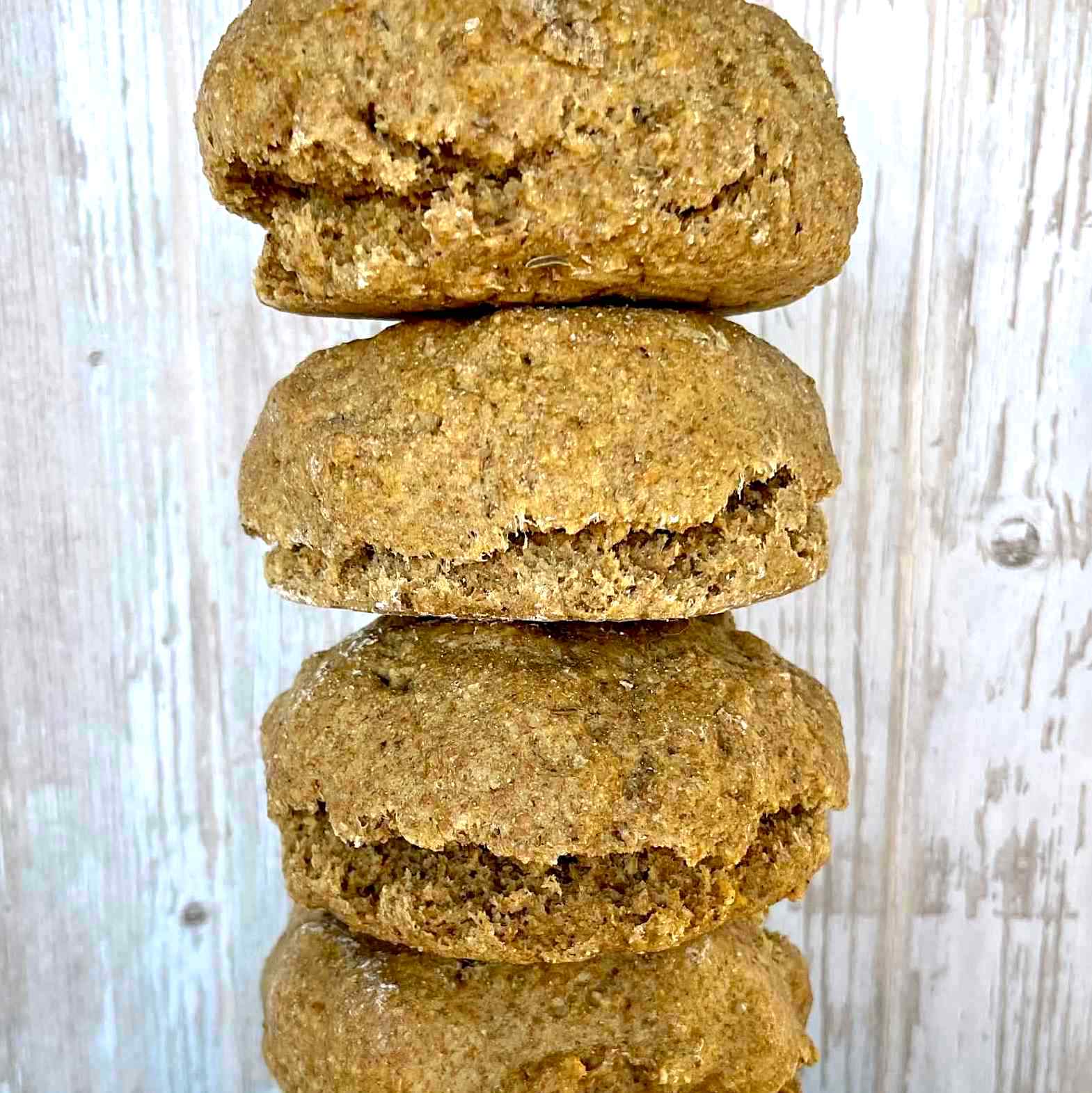
These rustic savory biscuits are made in a food processor and don’t need rolling. You can cover them with gravy, serve them with a cozy bowl of soup, or use them to make healthy breakfast sandwiches. Whole food plant-based protein packed goodness with old world flavor!
WHY I LOVE THEM
These large healthy versatile biscuits have an unapologetically bold nutty flavor that reminds me of a very grainy Irish soda bread. I love them right out of the oven with a pat of tahini and a spoonful of berry compote. But because they’re decidedly savory, these biscuits are also delicious under piping hot gravy, making them an ideal meal component for holiday meals. If they’re not gobbled up the first day, I store them in the fridge for up to a week. They’re sturdy enough to be sliced down the middle and browned in a toaster. On busy mornings I can turn them into hearty breakfast sandwiches by filling them with my latest tofu scramble. Their high nutrient content—fiber and protein in particular—makes these biscuits filling and satisfying.

WHOLE SPELT FLOUR
Part of the wheat family, spelt is one of the oldest cultivated grains. Compared with most other wheat grains however, it has undergone minimal hybridization over the last few centuries. As an ingredient, whole spelt flour is interchangeable with whole wheat flour in almost all recipes. But interchangeable doesn’t mean identical. The nutritional profile is a little bit different with whole spelt flour having a bit more protein, zinc and copper than whole wheat. Spelt also soaks up less liquid than other wheat flours so ratios may need to be adjusted.
Using whole spelt flour in baking is an easy and delicious way to add variety to your diet. Whole grains are an essential component of a whole food plant-based practice. The greater the variety of whole grains we can get into our bodies, the greater the health benefits. So for me it has a lot to do with maximizing the health benefits of what I cook. Plus, spelt makes for a bouncy crumb which I enjoy in both sweet and savory bakes.
FOOD PROCESSOR NEEDED
This recipe relies on a food processor because the first step involves turning chopped walnuts and a portion of the liquid ingredients into a paste that serves as a whole food plant-based substitute for butter or shortening. After creating the paste, the dough itself comes together in the same food processor in less than a minute. I got the walnut and food processor method from Jane and Anne Esselstyn’s cookbook, Be A Plant-Based Woman Warrior, specifically their recipe for “Jane’s Tall Flax Biscuits.” I love how walnuts are transformed into a whole food plant-based (WFPB) adherent way to create a biscuit experience that’s reminiscent of traditional American cooking. But unlike traditional ingredients like butter or shortening, walnuts are packed with fiber, protein and other essential nutrients.
VINEGAR IN VEGAN BAKING
Vinegar is a common ingredient in vegan baking. Adding a small amount of vinegar to vegan baked goods can achieve the same slightly tangy taste that traditional recipes get from ingredients like buttermilk and sour cream. Advanced vegan bakers sometimes use plant derived lactic acid to do the same thing. I actually have some powdered lactic acid which I’ve used instead of vinegar, but I don’t include it in my recipes because it’s an ingredient most people won’t have. And anyway, in my opinion, the results aren’t noticeably better than with using apple cider vinegar. Plus, the advantages of vinegar go beyond the tang. Vinegar can help disrupt the protein bonds in flour leading to a more tender crumb. When combined with baking soda, vinegar can intensify the leavening action of the baking soda by producing carbon monoxide gas.
In this recipe I use vinegar in the initial step of creating a walnut paste because that walnut paste then comes into direct contact with the flour before most of the plant milk is added. My goal is to tenderize some of that coarse whole spelt flour as much as possible through less diluted contact with the vinegar.
PROCESSING
The first step is to place chopped walnuts, vinegar and one tablespoon of plant milk in the bowl of a food processor then pulse to form a coarse paste. After that, add all dry ingredients except the caraway seeds and pulse a few more times until you get a sandy, slightly lumpy, mixture.


Then add the remaining plant milk and pulse just three or four more times until the ingredients have almost, but not completely incorporated. At this point it’s almost always necessary to scrape down the sides of the bowl with a silicone cake spatula to keep everything together. Finally, add the caraway seeds, and pulse a couple of more times until a smooth ball forms. I add the caraway seeds at the very end like this so that they stay as whole as possible and don’t get ground up.


FORMING AND BAKING
The dough for these biscuits is stretchy, elastic, and easy to work with. I think it’s less trouble to shape the biscuits by hand than to roll them and cut them with a glass or biscuit cutter. If you prefer a tidier, less rustic, look you can go ahead and use the rolling method with this dough. Instead of rolling, I prefer making six balls as close to the same size as possible and pressing them down with my hands. Dividing the dough into six parts makes for fairly large biscuits which is what I prefer, but if you want smaller biscuits you could easily get eight to ten biscuits from this batch. Note that smaller biscuits will probably require a shorter cooking time.

I’ve tried baking these biscuits two different ways. One was to place biscuits on a cookie sheet about two inches apart. The second was to crowd them together in a 9 x 13 inch pyrex pan. Both methods worked. The biscuits baked in a pyrex pan took a couple of extra minutes to cook. I liked the cookie sheet method better because the outer layer of the biscuits came out a little crispier. For both methods, the oven temp was 400 °F (200 °C).


VARIATIONS
- Oat Flour for a Gluten Free Version: If you are gluten free and include gf oats in your diet, these biscuits can be made using oat flour instead of whole spelt flour. This is not exactly a one-to-one substitution. Start with two cups of oat flour adding a little more if the biscuit dough is too wet to handle.
- Use a Different Type of Whole Wheat Flour: This recipe works well with regular whole wheat flour, whole wheat pastry flour, or whole einkorn, but it’s usually not exactly a one-to-one substitution. Start with two cups of oat flour adding a little more if the biscuit dough is too wet to handle.
- Use a Different Type of Seed: Get creative with seeds. Fennel seeds are lovely in this recipe. Poppy, sesame or hemp seeds are also good. You could also use a mix of several seeds.
- Add Raisins or Dried Currants: For a sweeter, more unusual, biscuit experience you can add raisins, dried currants or even dried cranberries to this recipe. Note that adding dried fruits makes these biscuits less suitable for gravy and sandwiches.
more recipes you’ll love


Easy Vegan Spelt Caraway Biscuits WFPB

Equipment
- Cookie Sheet (a 9 x 13 inch pyrex pan also works)
- Parchment Paper
- medium bowl
- Food Processor
- Cake Spatula
Ingredients
- 2¼ cup whole spelt flour*
- 3 Tbsp ground flaxseed
- 1 tsp baking soda
- ½ tsp baking powder
- ¼ tsp salt (optional)
- ½ cup chopped walnuts
- 1 Tbsp apple cider vinegar
- 1 cup + 1 Tbsp plant milk (divided)
- 2 tsp caraway seeds
Instructions
- Line baking sheet with parchment paper and preheat oven to 400 ℉ (200 ℃)
- In a medium bowl combine whole spelt flour, ground flaxseed, baking soda, baking powder and salt (if using). Set aside.
- Place chopped walnuts, apple cider vinegar and 1 tablespoon of plant milk in the bowl of a food processor and pulse several times until you achieve a relatively smooth paste. You may need to use a cake spatula to push down walnuts pieces on the side of the bowl.
- Add the mix of dry ingredients to the walnut paste in the food processor and pulse a 3 or 4 times until you get a sandy, slightly lumpy, mixture.
- Add remaining plant milk and pulse another 3 or 4 times until the ingredients have almost, but not completely incorporated. If necessary, use your cake spatula to scrape down the sides of the bowl to keep everything together.
- Add the caraway seeds, and pulse 2 or 3 times until a smooth ball forms.
- Shape dough into 6 balls** of equal size. Place balls on baking surface approximately 2 to 3 inches apart*** and press each ball down with your hands to create a disk shape that's about 1 inch thick.
- Bake in preheated 400 ℉ (200 ℃) oven for 12 to 14 minutes. When done, biscuits should be golden on top.
- Serve immediately or cool and store in an air tight contain (they'll stay fresh longer in the fridge) and reheat when ready to serve.


Leave a Reply