
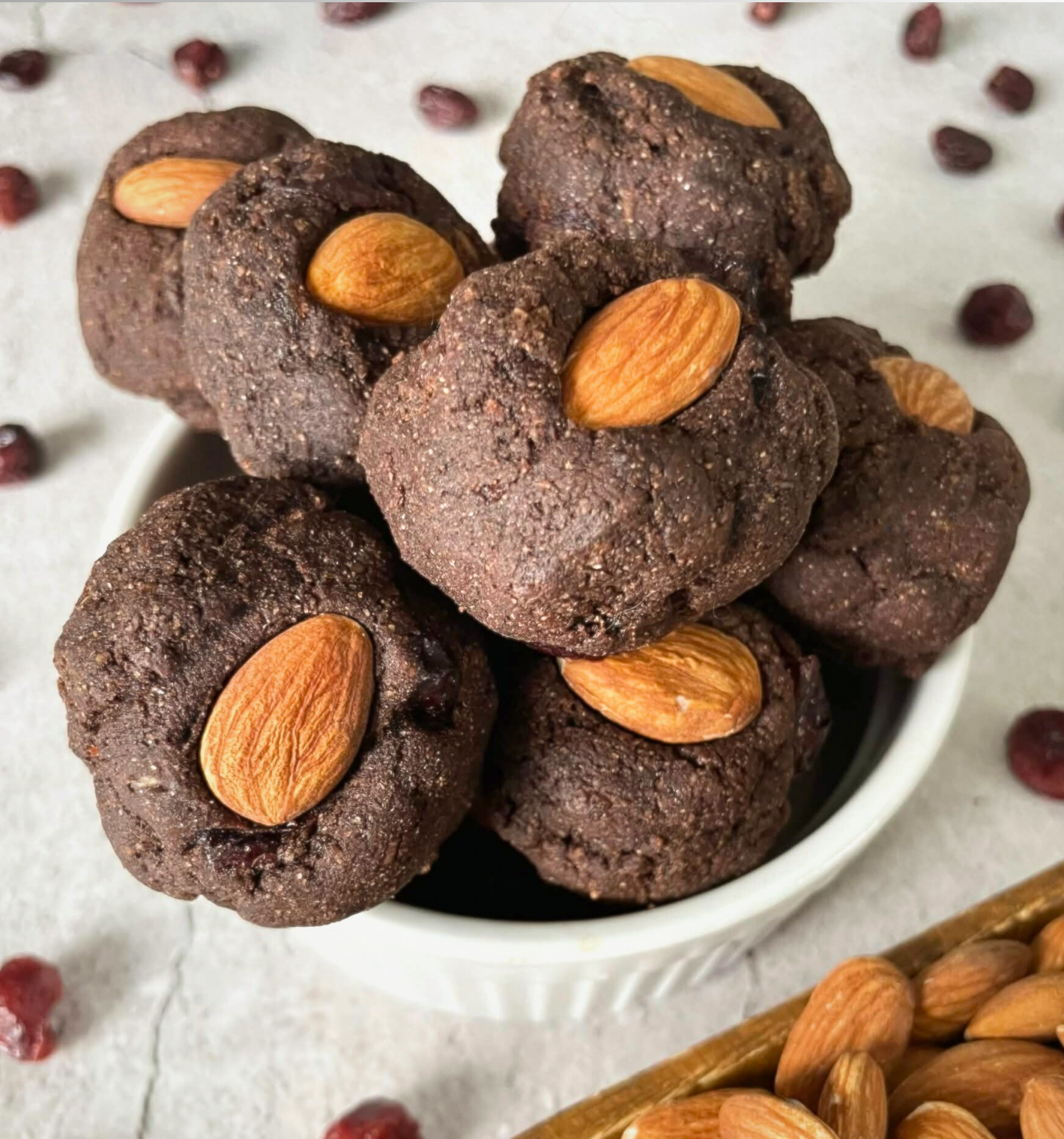
A healthy homemade alternative to pricey processed energy bars, these fudgy gluten-free baked treats are made with chickpea flour and dried cranberries. Plant powered protein-packed snacking doesn’t get any more satisfying!

WHY I LOVE THEM
As an outdoor enthusiast, traveler and all around busy person, I’m always looking for convenient and delicious snack options that will keep me nourished in a whole food plant-based (WFPB) adherent way. These energy balls are sturdy enough to be toted around in a backpack without crumbling. Whether I’m halfway through a long hike or spending the day at the beach, I can count on them to delight my tastebuds, satisfy my hunger and keep me energized. As a whole food vegan traveler, I often find myself in environments where a tossed salad and a bowl of rice are the only restaurant options available. But if I’ve packed these energy balls, a tossed salad and a bowl of rice are all I need to add to my day to achieve balanced plant-based nutrition. These little wonder are packed with protein and all sorts of important nutrients. There’s a legume by way of the chickpea flour, a nut, a seed, and three different fruits, all while being fudgy and indulgent. When I set out to create this recipe my main goal was to make a tasty cookie-like thing using carob powder, an ingredient which I believe to be underappreciated. It took a while, but the result has been one of the most useful recipes I’ve ever concocted. To me they taste better than any commercial energy bar I’ve ever had and they’re made exclusively from whole plant ingredients.
CAROB: POISED FOR A COMEBACK
A few years back there was a meme circulating that said “the hippies were right about everything.” As someone who loosely identifies as a hippie, I tend to agree. But the truth is a little more nuanced. It’s more accurate to say that the hippies were on the right track about a lot of things. Carob, an ingredient which rose in popularity during the flower power era, is a case in point. The hippies were right that carob is a wonderful nourishing ingredient. But they were wrong about it being the perfect chocolate substitute or that chocolate even needed a substitute. The remarkable health properties of cacao were not widely known in the mid 20th century when chocolate was seen as nothing more than an indulgent sugary, high-fat, confection. Carob gained popularity because it was seen as a healthier chocolate alternative. But well intentioned hippie moms who raised their children on carob chip cookies were inadvertently creating a generation of carob disappointment. As soon as their kids got their hands on a real chocolate chip cookie they became convinced that carob was a fraud. Later, as adults, those kids would discover that chocolate had been healthy all along and they doubled down on their carob resentment.
It’s time to give carob a chance again. Not because it’s a perfect chocolate substitute but because it’s a healthy, versatile and delicious ingredient in its own right. Unlike cocoa powder which usually requires extra sweetening in order to be palatable, carob contributes its own sweetness. In vegan baking, carob powder works as a gluten-free binder, the structural glue that hold everything together. Non-vegan bakers often rely on eggs to be the primary binder especially in gluten-free recipes. But because vegans don’t consume eggs, any plant-based ingredient that helps with binding is extremely helpful. Carob powder has fewer calories and significantly less fat than cocoa powder, plus it has a lot more calcium and no caffeine. Because it contains no oxalic acid, it’s ideal for those who need to limit oxalates. Finally, from a climate change and sustainability perspective, growing carob beans may be a better choice than cocoa beans because carob trees are more drought and heat resistant.
WHAT DOES CAROB TASTE LIKE?
There’s no way around it, carob is indeed similar to chocolate. But carob has an earthier, more mellow, malt-like nutty flavor and a subtle sweetness. I think of chocolate as an edgy sophisticated theater diva and carob as her sensible cousin who prefers to work backstage. Carob doesn’t like the spotlight, it’s more of a team player and needs help from surrounding ingredients in order to achieve deliciousness.
CHICKPEA FLOUR ADVANTAGES
Chickpea flour, also called garbanzo bean flour or besan, is a wonderful ingredient for gluten-free vegan baking. Its fine texture makes it especially good in cookies and energy balls and the nutritional profile is exceptional—high in protein and fiber with an abundance of vitamins and minerals, a low glycemic index and some beneficial antioxidants. There’s more chickpea flour in these energy balls than any other single ingredient and that’s partly why they’re so nourishing.
FRESHNESS IS CRUCIAL
Please check the expiration date when purchasing chickpea flour as it can go rancid if old or not stored correctly. Once you bring it home, I recommend keeping it in the freezer, or at least the fridge, to extend shelf life as much as possible. Uncooked chickpea flour often tastes a little bitter, but if it tastes very bitter or if it smells rancid or fishy, you can’t use it.
TOASTING CHICKPEA FLOUR
In order to optimize the flavor of chickpea flour in baked goods you should toast it first. Toasting tones down the beany flavor that some people taste and eliminates bitterness. My preferred method for toasting chickpea flour is in a saucepan over medium heat for 5 to 10 minutes, stirring constantly. I stop as soon as I see a slight change in color because I’m afraid of burning it, usually after 6 or 7 minutes.


DATES FOR WFPB SWEETNESS
Dates are a nourishing ingredient in their own right, and in this whole food plant-based (WFPB) recipe they are also the primary source of sweetness. The dates will be processed into the apple sauce so that their caramel-like sweetness can be evenly infused throughout the energy balls in a way that resembles a refined sweetener. Chopping the dates before processing makes them easier to pack into a measuring cup while giving me a chance to check for and remove any pits or hard bits.
My favorite dates for cooking are pitted Deglet Noor because they’re sweet, flavorful, widely available and usually soft and moist. You can also use medjool, or any other kind of date.

FOOD PROCESSOR RECOMMENDED
This recipe requires either a food processor or blender in order to break up the dates. I prefer to use a food processor because it allows me to do all of the messy stuff inside the processor bowl thus minimizing the cleanup process.
BLENDER METHOD
If all you have is a blender, you can create the sweet paste in a blender then combine it with the dry ingredients in a medium or large mixing bowl using your hands, a wooden spoon or a very firm silicone spatula. The advantage of this method is that folding in the cranberries is a little easier this way.
CREATING A SWEET PASTE
Processing these energy balls begins with making a paste with the apple sauce, dates and almond extract. All you need to do is to pulse until the dates are broken down into very tiny pieces. You can pulse until the paste is completely smooth if you want, but it’s not necessary.


FORMING THE DOUGH
The dry ingredients are mixed in a separate bowl ahead of time and the dried cranberries are added last after everything comes together. To form the dough you just pulse until the dry ingredients are incorporated into the apple sauce date paste and a thick sticky dough forms. Chances are you’ll have to stop and use a silicon spatula to push down on the sides of the food processor.


FOLDING IN THE CRANBERRIES
This is where things start to get messy. First you carefully remove the blade of the food processor. Then you add the dried cranberries to the bowl and use a firm spatula or a wooden spoon to evenly distribute them throughout the dough. Be sure to un-clump the dried cranberries before trying to fold them into the dough.


DEALING WITH STICKINESS
Things get even more messy when you’re shaping the energy balls because this dough sticks to your hands quite a bit. You can minimize the stickiness of the dough by refrigerating it for an hour or so before shaping the balls. Simply cover the food processor bowl with a plate and place in the fridge. Another way to deal with the stickiness is to put some water in a small bowl that you keep close at hand to wet your hands before shaping each ball. I don’t do either of these things and just let my hands get messy. Although the dough is sticky, it’s not all that difficult to shape.
SHAPING THE BALLS
Make 16 to 18 equally sized balls and place them on a parchment paper lined cookie sheet. The balls should be 1.5 to 1.75 inches (roughly 3.8 to 4.4 cm) in diameter. They will barely expand so don’t worry about keeping them far apart, an inch or so is plenty for heat circulation. After the balls are shaped, push a whole raw almond into the center of each ball, sinking the almond in about a quarter inch so they don’t pop up during or after baking.

SUBSTITUTIONS
The following ingredients are easily substituted. Here are some suggestions for alternatives.
- Chickpea Flour: You can use almost any kind of flour for this recipe. To keep things gluten-free and whole food plant-based my top suggestions are oat flour or buckwheat flour. I tried brown rice flour, but it made the cookies too gritty for most people (I liked the taste though). Non WFPB gluten-free options include any gf flour blend or cornstarch. If you don’t need these energy balls to be gluten-free you have even more options like whole wheat flour, whole spelt flour or whole rye flour.
- Almond Flour: Any other nut flour would also work such as pecan, hazelnut or cashew or you can make your own sunflower seed flour.
- Dried Cranberries: You can use dried cherries or raisins instead. Another option would be to use a larger dried fruit like dried apricots, chop it into small pieces and dredge with a teaspoon or two of starch before adding them in.
- Ground Flaxseed: Ground chia seeds can be used instead. You can also use hemp seeds which would keep things high in nutrients but will result in a slightly different texture.
- Pumpkin Spice: You can use ground cinnamon, allspice or apple pie spice instead.
- Almond Extract: You can use 1 teaspoon of vanilla extract instead.
- Whole Raw Almonds: Use any other whole raw nut instead or leave whole raw nuts out altogether.
related recipes you’ll love


Carob Almond Energy Balls Vegan Gluten-Free Date-Sweetened

Equipment
- Cookie Sheet
- Parchment Paper
- small saucepan or skillet
- medium bowl
- Food Processor (refer to BLENDER METHOD section in main recipe text if you need to use a blender instead)
- silicon spatula
- Wooden Spoon (optional)
Ingredients
- 1 cup chickpea flour*
- ½ cup almond flour*
- ½ cup carob powder
- 1 Tbsp ground flaxseed*
- 1 tsp pumpkin spice*
- ½ tsp baking powder
- ½ tsp baking soda
- ¼ tsp salt
- ½ cup dates, chopped and well packed**
- ½ cup apple sauce
- ½ tsp almond extract*
- ½ cup dried cranberries,* un-clumped
- 2 Tbsp whole raw almonds* (or 1 almond for each of the 16 to 18 energy balls)
Instructions
Prep for Baking
- Line a cookie sheet with parchment paper.
- Preheat oven to 350 ℉ (175 ℃)
Toast Chickpea Flour
- Place saucepan or skillet over medium heat. Add chickpea flour and stir constantly for 5 to 10 minutes until the chickpea flour becomes golden. As soon as the chickpea flour is toasted, transfer it into a medium size bowl.
Mix Dry Ingredients
- To the chickpea flour in the bowl add the almond flour, carob powder, ground flaxseed, pumpkin spice, baking powder, baking soda and salt. Mix ingredients until they are evenly distributed and set aside.
Create Sweet Date Paste
- If you're using a blender instead of a food processor, please read the BLENDER METHOD section in the main recipe text.
- Place chopped dates, apple sauce and almond extract in the bowl of a food processor. Pulse until the dates have broken down into tiny pieces. You can pulse until completely smooth if you like, but it's not necessary.
Create the Dough
- Add the mixed dry ingredients to the sweet date paste in the food processor and pulse until a dough forms. You will probably need to open the food processor and push the sides down once or twice to get everything evenly incorporated.
- Carefully remove the blade from the bowl of the food processor while leaving all of the dough in the bowl.
- After checking to make sure none of the dried cranberries tare stuck together, fold them into the dough using a firm silicon spatula or wooden spoon.
Shape Energy Balls
- Make 16 or 18 equally sized balls and place them on the parchment paper lined cookie sheet. To get this many balls they need to be about 1½ to 1¾ inches in diameter (3.8 to 4.4 cm) in diameter. The dough will be sticky. You can refrigerate it for a while or wet your hands while you work with it to make it more manageable if you like though I don't find it necessary to do either of those things.
- Push a whole raw almond into each ball, sinking the almond ¼ inch so that it doesn't pop out during or after baking. Be careful not to flatten out the ball too much when you push in the almond.
Bake
- Bake at 350 ℉ (175 ℃) for 10 minutes.
Serve or Store
- You can serve energy balls immediately out of the oven, but they're better after they've cooled down.
- After the energy balls have cooled down completely they can be stored in a sealed container at room temperature or in the fridge, and can also be kept frozen and thawed as needed.



Leave a Reply