
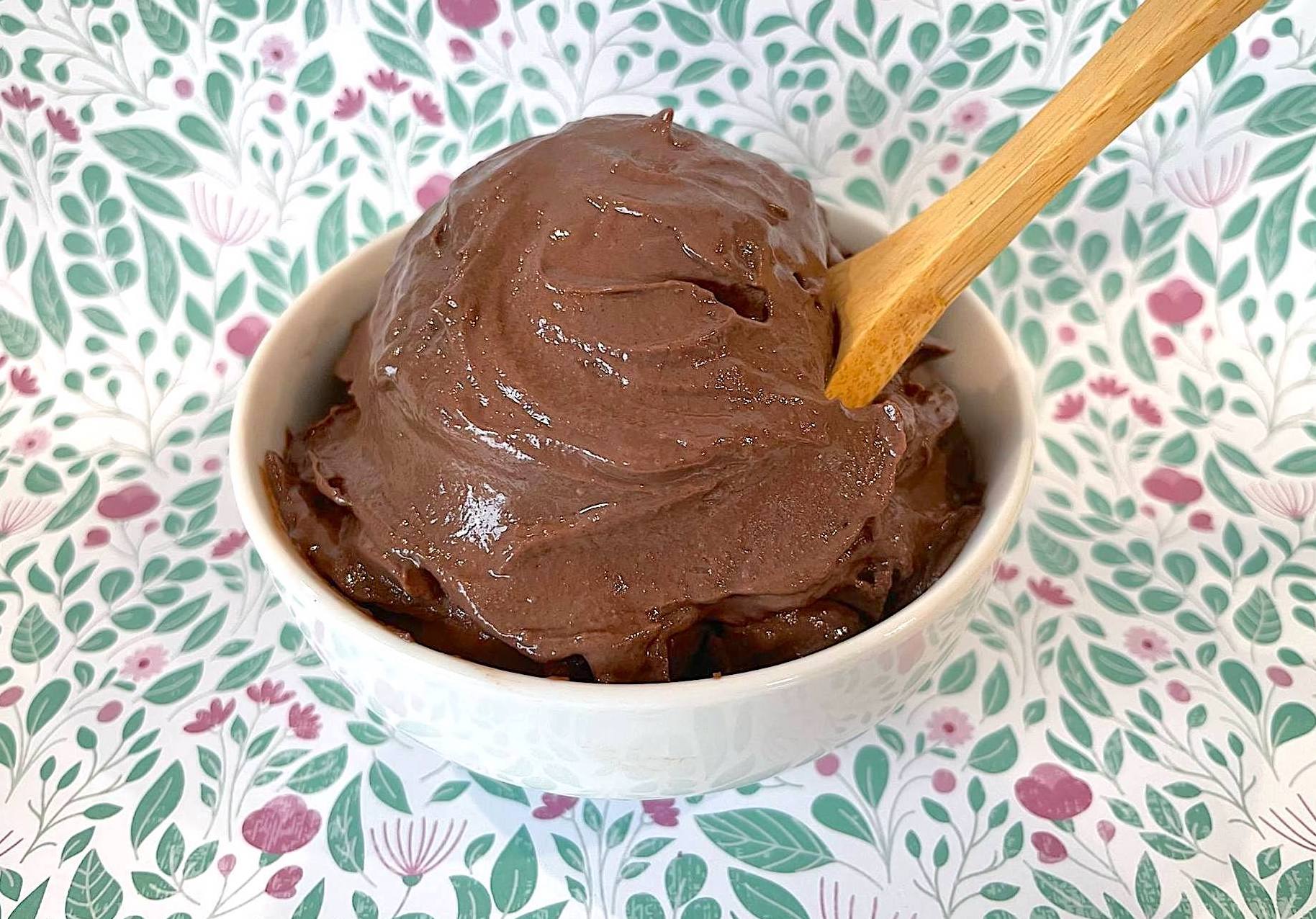
Sinfully rich, silky smooth, intensely chocolaty and very sweet, this is the ultimate plant-based chocolate dessert. With only five ingredients and no heat required, this custard is every vegan chocolate lover’s dream come true. But wait, it gets better. This creamy concoction is also good for you and you can use it as a frosting.
WHY I LOVE IT
With a little prep time and ingredients that I usually have on hand, this ridiculously delicious stand-alone dessert or frosting can be whipped up in minutes. As someone who strives to be as whole food plant-based (WFPB) compliant as possible, it can be hard to find sweet creamy dessert options that don’t rely on refined sweeteners and added fats. Commercially, these options almost don’t exist at all, and even most self-described whole food plant-based recipes rely on refined ingredients like maple syrup for sweetening. But thanks to the life changing magic of my high speed blender and vegan pantry staples like pitted Deglet Noor dates, cocoa powder and shelf stable silken tofu, I can make my own indulgent fudgy concoction that’s consistent with a whole food plant based life style.

SERVING SIZES AND DOUBLING RECIPE
This recipe makes approximately 1-1/2 cups of custard. That’s enough for four servings that are a little more than 1/3 cup each, a reasonable serving size for something that tastes this rich. If you’re using this recipe for frosting, this is the perfect amount for dressing up my Red Bean Brownies or to turn Chocolate Banana Muffins into decadent cupcakes, but it won’t be enough for a two layer cake or for a single layer cake that’s larger than 9 inches. Keep this in mind and double the recipe if you need to. You won’t regret having too much of this stuff and it will keep in the fridge for at least a week in an air tight container.


COCOA POWDER IS A WHOLE PLANT FOOD
Rejoice! Cocoa powder is a whole plant food with a number of nutritional benefits. Although processing is involved, cocoa powder is derived from whole seeds of the cacao tree, and retains many of the nutrients present before processing including fiber, antioxidants and minerals like iron, magnesium, copper and zinc. There are two types of cocoa powder: natural and Dutch-processed, a.k.a. European-style cocoa powder. If you want to maximize the nutritional benefits of cocoa powder, go for natural instead of Dutch-processed because in removing some of the acidity, the Dutch processing technique also decreases flavanol content. And flavanols are powerful antioxidants with a variety of health enhancing benefits. But that doesn’t mean that Dutch-processed cocoa is bad for you, only that it’s a little less good. Natural cocoa powder will always be more acidic. If the tang bothers you, then go with Dutch-processed.
SHELF STABLE SILKEN TOFU
The versatility of silken tofu for plant-based cooking can’t be overstated. It’s nice to have a shelf stable version ready to go on your pantry shelf, no refrigeration needed, and usually good for at lest one year. It can go in desserts, scrambles, dips, spreads, smoothies and more. I stock up whenever I’m at my favorite Asian grocery store, but you can often find it at regular grocery stores in the non-refrigerated Asian foods section, or order online. I usually get firm or extra firm. For this recipe, I recommend extra firm.

THE MAGIC OF DATES IN WFPB RECIPES
My sweet recipes get most of their sweetness from whole dried fruits, and my go to dried fruit for sweetening recipes are dates. Dates are intensely sweet with a rich caramel-like flavor. When processed in a high speed blender with other ingredients, dates work as a binder, holding mixtures together. Pureed dates also help to lock in moisture, acting as a substitute for added fats in whole food plant-based frosting recipes. From a nutritional standpoint, dates are a whole plant food packed with fiber and a symphony of other nutrients.
PREPPING AND MEASURING DATES
My favorite dates are pitted Deglet Noor because they’re sweet, flavorful, widely available and usually soft and moist. You can also use medjool dates by prepping and measuring them in the same way as you would Deglet Noor.
When I use dates in recipes I always begin by slicing them. I have found that dates that are supposedly pitted are, in fact, usually not all pitted. Pre-slicing my dates gives me the opportunity to examine them and remove any hidden pits and hard stems that may still be attached to the dates. In recipes like this one where the dates will be processed in a blender or food processor, slicing the dates allows them to be processed more quickly and effectively.
Last but not least, slicing dates allows for greater consistency in volume measuring. Once the dates are sliced they can be pressed into measuring cups or spoons.

REMOVING EXCESS LIQUID FROM SILKEN TOFU
For this recipe, I remove as much moisture from the firm, or extra firm, silken tofu as possible. If you have a tofu press, trust me, you don’t want to try to use it for this. Silken tofu is way too soft for a tofu press. Instead, I use a cheesecloth or several absorbent lint-free cloths. First I drain off the obvious liquid from your tofu as soon as it comes out of the box. After that, there are a couple of different ways to proceed with the moisture removal. One way is to wrap it with a couple of lint-free, absorbent, cloth napkins or dish towels, place it on a plate and put something heavy on it, like another plate, and leave it like that overnight or for up to 24 hours inside the fridge. This works if you have the time. But keeping in mind that for this recipe the tofu does not need to keep its shape, I prefer to use a cheesecloth, or similar type of fabric, over a mesh strainer to squeeze the liquid out of the tofu. I start by placing my mesh strainer over a bowl. Then I place the cheesecloth over the mesh strainer. The mixing bowl under the strainer is there to catch the excess liquid. I place the tofu over the cheese cloth and begin crumbling it using a spoon or my fingers. Part of the liquid is released right away. Then, to remove as much of the liquid as possible, I wrap the cheese cloth around the crumbled tofu and gently squeeze. When I feel like I’ve gotten most of the liquid out of the tofu, I carefully remove the tofu crumbles from the cheese cloth and place them in a small bowl while I gather my other ingredients. The liquid captured in the bowl under the strainer can be discarded.


HIGH SPEED BLENDER RECOMMENDED
For best results, a high speed blender should be used for this recipe. However, a less powerful blender, or even a food processor, can do a passable job so long as you’re patient. Modern appliances like high speed blenders allow us to quickly and easily harness the power of plant foods like dates, cashews and tofu, eliminating the need for ingredients like sugar, butter and dairy cream which are calorie dense and comparatively low in nutrients.
related recipes you’ll love


Healthy Vegan Chocolate Custard or Frosting Sugar-Free Oil-Free Gluten-Free

Equipment
- High Speed Blender (a food processor or regular blender will work with some patience)
- Cheesecloth (or other thin absorbent lint-free fabric for squeezing tofu)
Ingredients
- 1 10.9 oz package shelf stable silken tofu, firm or extra firm
- ⅔ cup Deglet Noor dates, sliced then measured
- 6 tablespoons cocoa powder
- 1 teaspoon vanilla extract
- 2 to 4 tablespoons unsweetened plant milk
Instructions
- It's important to remove as much excess water as possible from the silken tofu in order to maximize flavor and achieve the right level of firmness. You will need cheesecloth or several absorbent lint-free cloths. First drain off the obvious liquid from your tofu as soon as it comes out of the box. After that there are a couple of different ways to proceed with the moisture removal. One way is to wrap it with a couple of cloth napkins or dish towels, place it on a plate and put something heavy on it, like another plate, and leave it like that overnight or for up to 24 hours inside the fridge. This works if you have the time. But keeping in mind that for this recipe the tofu does not need to keep its shape, I prefer to use a cheesecloth, or similar type of fabric, over a mesh strainer to squeeze the liquid out of the tofu. I start by placing my mesh strainer over a bowl. Then I place the cheesecloth over the mesh strainer. The mixing bowl under the strainer is there to catch the excess liquid. I place the tofu over the cheesecloth and begin crumbling it using a spoon or my fingers. Part of the liquid is released right away. Then, to remove as much liquid as possible, I wrap the cheese cloth around the crumbled tofu and gently squeeze. When I feel like I've gotten most of the liquid out of the tofu, I carefully remove the tofu crumbles from the cheese cloth and place them in a small bowl while I gather my other ingredients. The liquid in the bowl is discarded. This excess liquid is not particularly tasty. Part of the moisture you're taking out will be reintroduced in the form of better tasting, nutrient rich, plant milk.
- Place the tofu with liquid removed, dates, cocoa powder, vanilla extract and 2 tablespoons of the plant milk in the bowl of a high speed blender (you can use a food processor or regular blender for this step, but it will take longer and your results may not be as smooth). Process until a smooth custard forms, adding extra plant milk, a tiny bit at a time, if you see that the mixture is too dry to come together. The amount of extra plant milk you need (if any) will depend on how much liquid you managed to extract from your silken tofu and the moisture level of the dates you're using. Both these factors can vary quite a bit. Remember that less is more when it comes to adding plant milk. You want your custard to be as thick as possible while also being as smooth as possible.
- Remove mixture from blender and place in an air-tight container. Store in the fridge for up to a week. If you are using this custard as a frosting, chill for at least two hours before spreading. It can be served immediately if using it as a stand-alone dessert, or as a creamy dessert topping.
- This recipe makes approximately 1-1/2 cups of custard. That's enough for four servings that are a little more than 1/3 cup each, a reasonable serving size for something that tastes this rich. If you're using this recipe for frosting, this is the perfect amount for dressing up Red Bean Brownies or to turn Chocolate Banana Muffins into decadent cupcakes, but it won't be enough for a two layer cake or for a single layer cake that's larger than 9 inches. Keep this in mind and double the recipe if you need to.



Leave a Reply to Ingrid SojitCancel reply