
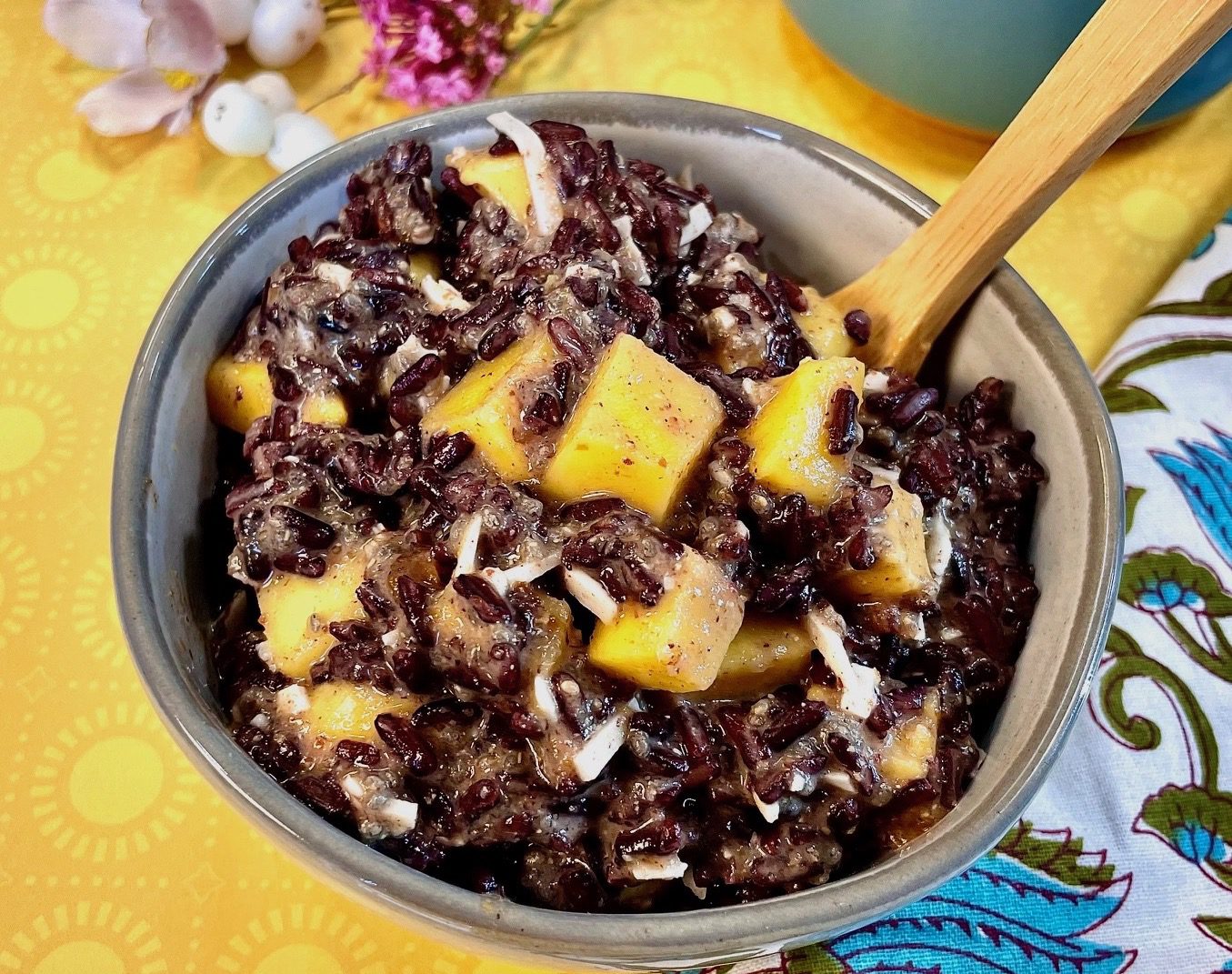
Nutritious and flavorful sweet breakfast bowl inspired by a classic Thai dessert. This recipe started out as a way to use up leftover black rice from another recipe, and it’s become one of my favorite breakfasts. Secretly sweetened with dried fruits, it contains a powerhouse nourishing ingredients including ground flaxseed meal and chia seeds.
A VEGAN FUSION BREAKFAST IDEA
This breakfast bowl was inspired by a dessert offered at many Thai restaurants. I love Thai food. Wherever I am in the world, so long as I can find a Thai restaurant, I know I’ll be able to have a tasty and well balanced plant-based meal. These days I avoid ordering desserts at restaurants because I’m trying my best to keep sugar and other refined sweeteners out of my life and that’s almost impossible to do with restaurant desserts. But I’ve been known to make an exception or two, especially at Thai restaurants where, if I’m lucky, I’ll find one of my favorite desserts: mango and black sticky rice.
Although the classic Thai dessert has sugar and sinfully rich processed coconut milk, the most important ingredients, mango and black rice, are whole plant foods. And the yummy coconut flavor can be found in unsweetened grated coconut which is a whole plant food that I usually have in my pantry. So one day I decided to try to make a pudding-like whole food plant-based concoction with some leftover cooked forbidden rice and frozen mango. I often use dried fruits, especially dates and prunes, as a sugar substitute in my baking, and decided to try the same approach to sweetening the rice. The result was more of a healthy breakfast bowl than a delicate dessert. Instead of tweaking my recipe to make it more dessert-like, I decided to lean into the breakfast bowl concept. My recipe evolved into a nutrient dense, satisfying, breakfast that I usually prepare the night before.

WHY I LOVE BLACK RICE
Black rice also goes by the name purple rice and forbidden rice. The scientific name for this species of grain is Oryza sativa L. indica. Black rice is not to be confused with wild rice, a Zizania species, which is awesome in its own right, but not what I’m using in this recipe. Compared with white or brown rice, black rice has more protein, fiber, iron and certain antioxidants. It has a rich texture and the flavor is slightly nutty and a bit bold. Although its caloric density is similar to that of other kinds of rice, I find that black rice is more filling and satisfying. The taste and look of black rice may not be subtle enough for every recipe, but it’s a wonderful grain to include in your plant-based repertoire.
FRESH OR FROZEN MANGOS
My whole food plant-based lifestyle requires having plenty of fruit on hand all the time. Frozen fruits are an easy and economical way to do this. But not all frozen fruits are equally versatile. Frozen bananas, for example, are great freezer staple because I use them for baking, smoothies and nice cream, but they’ll never replace fresh bananas in my peanut butter and banana sandwiches. The utility of frozen strawberries is even more limiting as almost everything I do with strawberries requires that they be fresh. Thawed strawberries are just too mushy for most of my purposes. This is not the case for frozen blueberries which I often prefer over fresh. Like blueberries, mangoes freeze and thaw extremely well. Frozen mangoes are especially convenient because they are already peeled and cut into large chunks. For this recipe, ripe fresh mangoes are terrific, but frozen mangoes are almost every bit as good, so go with whatever is most convenient for you.
HEALTHY SWEETENING AND THICKENING
Whole food plant-based (WFPB) cooking means using unprocessed, or minimally processed, whole plant foods as much as possible while avoiding refined ingredients such as oils, vegan butter, sugar, agave and, to a lesser extent, maple syrup. Of course, WFPB also means avoiding animal products as much as possible and for many of us, myself included, that means no animal products at all. Some of the ingredients we actively avoid in a WFPB lifestyle are the sole source of sweetness, thickening, moisture and binding in traditional cuisine, and in most vegan recipes. This doesn’t mean that our WFPB recipes can’t be sweet, creamy and moist, we just take a different path to get there.
Dried fruits, especially when blended with a liquid, not only allow us to achieve a desirable level of sweetness, they also act as a binder and thickener all while adding fiber, nutrients, and multiple layers of flavor. A blender, standard or bullet size, is the best way to create the dried fruit smoothies I use in many of my recipes, although you could also use a food processor or immersion blender. Remember to always chop your dried fruits before measuring and blending. Chopping makes measuring more accurate and allows you to remove any hard bits often present in dried fruits.
Chia and flax seeds, though they don’t contribute sweetness, are even better at thickening. The nutritional profile of these seeds is nothing short of spectacular, especially when it comes to omega-3 fatty acids. In this recipe, a smoothie made from dates, prunes and ground flaxseeds becomes a thick creamy base. The chia seeds are incorporated as an additional thickening component and for their nutritional contribution.


TOSS TOGETHER, EAT WHENEVER
Once your sweetening smoothies is ready all you need to do is add it to the rest of the ingredients in a large bowl and your breakfast bowls are ready to eat. This recipe makes two large portion bowls or about four small portion bowls. You can make this recipe the night before, store in one or several sealed containers and enjoy the following day. Refrigerating over night or up to 24 hours will actually improve the taste because the flavors come together more. Don’t ask me how this merging of flavors works. I don’t have a scientific explanation, but it’s one of those things that just happens to be true with many recipes!

REDUCING CALORIE DENSITY AND SATURATED FAT
Some of us are concerned about stubbornly high total cholesterol levels despite our WFPB adherence. In this case, we may want to restrict our consumption of whole plant foods with high levels of saturated fat including coconut. Those trying to reduce the caloric density in their diet in order to reduce or manage their body weight may be looking to restrict their consumption of the same group of foods. The shredded unsweetened coconut in this recipe adds a lovely flavor and texture, but if you need to stay away from coconut, one way to do this without missing out on the flavor is to substitute the shredded coconut with quinoa flakes. You can also add approximately 1/2 teaspoon of coconut extract added to the plant milk before blending. Another healthy shredded coconut substitute is freshly grated jicama. I happen to be someone who has to watch my saturated fat intake due to a genetic predisposition to high LDL levels, so I usually use one or all of these coconut substitutes.
related recipes you’ll love


Mango and Black Forbidden Rice Breakfast Bowl Vegan WFPB

Equipment
- blender (food processor or emersion blender can also be used)
Ingredients
- 2 cups cooked black rice (aka forbidden rice)
- 1-½ cups cubed mango, fresh or frozen (thaw first if using frozen mango)
- 1 cup unsweetened plant milk
- 3 Tbsp chopped deglet noor dates
- 3 Tbsp chopped pitted prunes
- 1 Tbsp ground flaxseed
- 3 Tbsp unsweetened shredded coconut*
- 2 Tbsp chia seeds
- ½ tsp ground cardamom
Instructions
- Place cooked black rice, cubed mango and unsweetened shredded coconut in a large bowl and set aside
- Check chopped dates and prunes for stems, pits or any kind of hard bits that shouldn't be there. Remove these if you find any
- Place plant milk, chopped dates, chopped prunes, and ground flaxseed in a blender and blend until smooth
- Add plant milk, date, prune and flaxseed blend to the bowl with the rice, mango and coconut. Using a wooden spoon or cake spatula, mix ingredients in the bowl
- Now add the cardamom and chia seeds to the bowl and quickly mix all the ingredients until everything is evenly distributed. You need to move fast to keep the chia seeds from clumping together as soon as they get wet
- Serve immediately, or refrigerate in a sealed container for up to 48 hours
- This recipe makes 2 to 4 servings



Leave a Reply to AyseCancel reply