
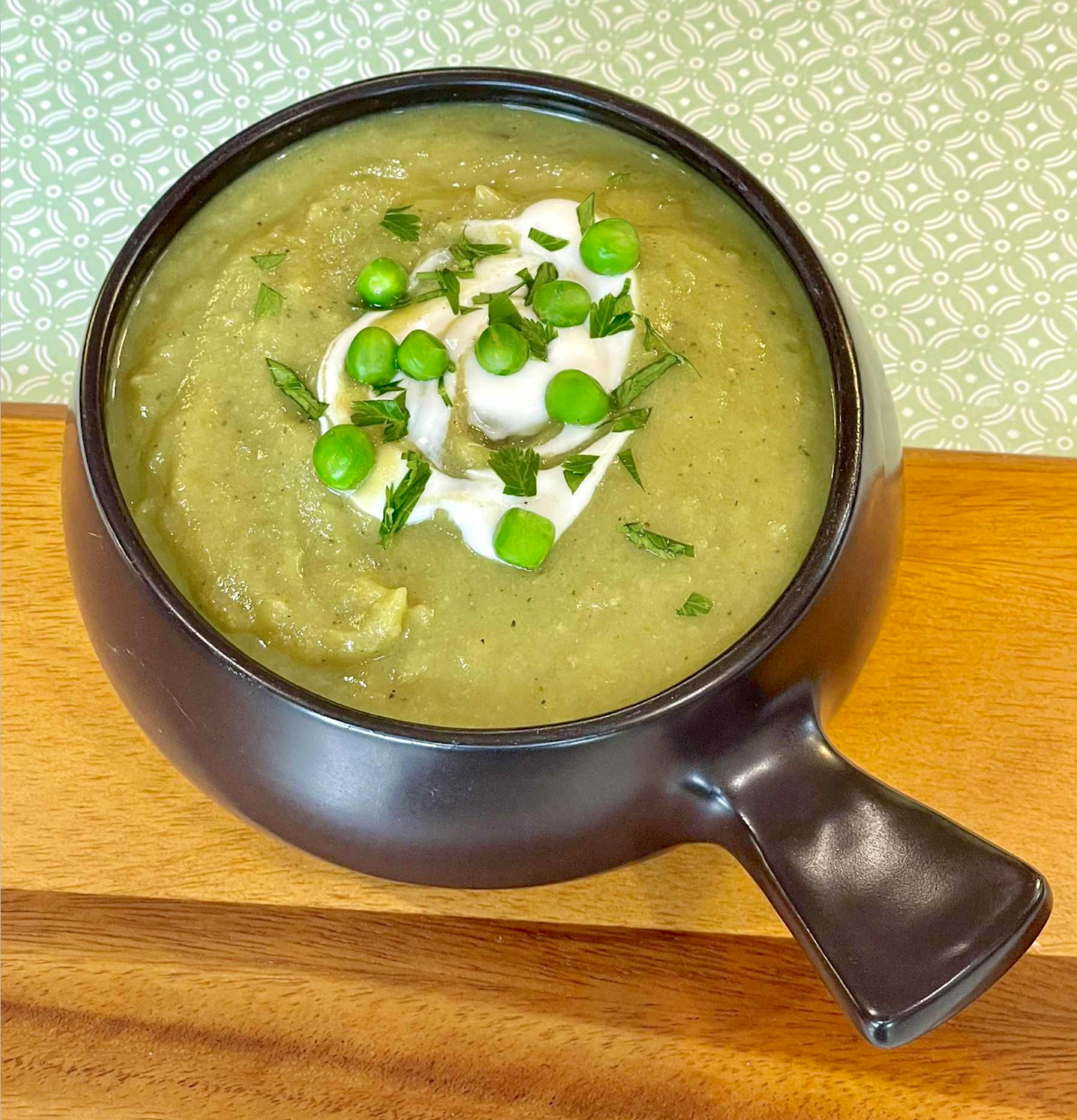
Simple to make and surprisingly filling! This comforting, nourishing, whole food plant-based soup combines fresh and frozen easy to find ingredients.

WHY I LOVE IT
Creamy green soups are a big part of my life. I turn to them for soothing nourishment and as a way to stay on track when I’m too busy to fuss with complicated meals. This recipe checks off a bunch of boxes for me—easy convenient ingredients, a pulse (peas!), a cruciferous vegetable, no saturated fat or added oil. The peas and zucchini make the flavor profile tilt slightly sweet. That sweetness is balanced by a bright citrusy pop of fresh lemon juice added just before serving. Despite the light gentle sipping experience, this soup is actually quite filling.
THE FROZEN VEGGIE ADVANTAGE
The convenience of frozen vegetables is undeniable. They are pre-washed, pre-chopped, won’t go bad before you get around to using them and are available year round. So why don’t foodies flock to the frozen food aisle more often? This part’s also pretty obvious: fresh veggies have a snappy crunchy texture that frozen veggies lack. That’s because when vegetables are frozen, water inside the cells of the vegetables turns into ice crystals that rupture the cell walls. Without sturdy cell walls vegetables will always be mushier. But here’s the thing, sometimes those ruptured cell walls are a good thing. Creamy soups are the perfect example of one of these times. In creamy soups it’s almost always better to cook the crunchiness out of the veggies before you blitz them with a blender. Frozen veggies are already part of the way there. This recipe lets you kick back and enjoy the convenience of the frozen vegetable aisle. Of course some of us also like to freeze our own fresh vegetables. When I made this soup I used fresh celery, zucchini, onion, and garlic. But there’s no reason why these vegetables can’t be pre-frozen as well. Because I happen to love the flavor of celery in soups and stews, I like to keep chopped celery in my freezer instead of letting a large bunch get limp in my fridge before I get around to cooking with it.
IMMERSION BLENDER RECOMMENDED
In order to create a creamy texture, you will need some sort of blender or food processor. An immersion blender is especially good for soups because it saves you the trouble of taking cooked ingredients out of the pot and into another container for processing. You could make this soup using a stand alone blender or food processor instead, but it’s a bit of extra work because you would have to let the soup cool a bit first then run it through in batches. Another way is to strain out all the vegetables, purée them separately from the rest of the broth, then mix them back into the broth and reheat.
SIMPLE OIL-FREE SAUTÉING
Although this is a soup where eventually most of the ingredients are simmered together for an extended amount of time, I still like to sauté the onions, celery, garlic and zucchini first in order to build flavor through caramelization. And yes, caramelization still happens when you’re not using oil for sautéing.
I like to use vegetable stock for sautéing because it intensifies the flavor, but water works perfectly well too. Usually, I make my vegetable stock by dissolving low salt stock cubes in water, but you can use any kind of vegetable stock—homemade, liquid concentrate, canned or boxed.
Begin by heating about 2 to 3 tablespoons of vegetable stock, or water, in a large pot over high heat. Keep more water or stock close at hand to use as needed. When the liquid in the pot comes to a rolling boil, reduce heat to medium-high and add chopped onions. Sauté for 5 to 6 minutes or until the onions become translucent, adding little bits of liquid as needed. Then add the garlic, celery and zucchini and sauté for another 10 to 12 minutes, adding liquid only when necessary to prevent burning and/or sticking.


Sautéing the frozen veggies and the potatoes for a few minutes before adding the broth and seasonings help develop a more complex flavor base. When vegetables come into direct contact with the hot pan a chemical process takes place called the Maillard reaction in which amino acids are heated causing browning. It’s 3 or 4 minutes of extra work for some browning that’s barely perceptible to the eye, but I think it’s worth it.


SIMMER TO SOFT AND BLITZ
After adding the vegetable stock, nutritional yeast and bay leaves (if using), bring up to a boil then reduce heat and simmer for about 20 minutes until the potatoes are very soft. The nice thing about an immersion blender is that you can process your soup while it’s still warm and inside the pot. Just remember to take out the bay leaves before blitzing if you can find them. I like my creamy soups to be very smooth and creamy so I’m patient with my immersion blender moving it around until it gets to everything, but you can leave your soup a little chunky if that’s what you prefer. Once you get the soup as smooth and creamy as you want it to be, all you need to do is add the fresh lemon juice and season with salt and pepper to taste.


VARIATIONS
- CHAYOTE SQUASH: This lovely pear shaped member of the gourd family may or may not be available where you live, but if it is I recommend giving it a try. Although you can eat the peel of chayote squash, for creamy soups I prefer peeling it. In this recipe you could use chayote squash as a substitute for zucchini or as an additional ingredient.
- SHIITAKE MUSHROOM POWDER: Boost the umami goodness and nutrient content of this soup by adding one tablespoon of shiitake mushroom powder. This amazing ingredient has a subtle flavor that is neutral, not mushroomy.
- USE A DIFFERENT HERB OR HERB COMBO: Many herbs would work in this recipe, so don’t be afraid to get creative. A simple handful of fresh parsley leaves could be nice or go with fresh basil for bolder flavor. Another wonderful choice is tarragon, dry or fresh. As a rule, fresh herbs go in at the end, minimizing their exposure to heat, while dried herbs are best added at the beginning of the simmering phase.
- CELERY LEAVES: If you live in the US, most of the leaves are removed from celery bunches before they arrive at the produce aisle. This is too bad because celery leaves are nourishing and packed with flavor. You can add up to a handful of celery leaves to this soup in the final stages of simmering—one or two minutes before turning off the heat is ideal.
related recipes you’ll love


Creamy Broccoli Pea Soup Oil-Free Vegan

Equipment
- Immersion Blender (a stand alone blender or food processor would also work)
- Large Cooking Pot (5 to 7 quarts is ideal)
Ingredients
- 5 to 6 cups vegetable stock, the amount depends on thickness desired (I use 2 to 3 bouillon cubes dissolved in water)
- 1 onion, chopped
- 3 to 8 garlic cloves, chopped (or 1 to 2 tablespoons of chopped garlic)
- 2 large celery stalks, sliced
- 1 medium-large zucchini, sliced (approximately 1½ cups sliced zucchini)
- 16 oz frozen broccoli florets (or the same amount of fresh broccoli)
- 1½ cup frozen peas (or the same amount of fresh peas)
- 1 large potato, chopped* (about ¾ to 1 cup chopped potato)
- 2 bay leaves (optional)
- 1 Tbsp nutritional yeast
- 1 tsp dried thyme
- 2 to 3 Tbsp fresh lemon juice (to taste)
- plant-based sour cream or plain unsweetened yogurt for garnish (optional)
Instructions
- Pour 2 to 3 tablespoons of vegetable stock into a large pot and bring to a rolling boil over high heat, keeping more stock close at hand.
- Add onions to pot, lower heat to medium-high, and sauté for 5 to 6 minutes until onions become translucent, adding a little bit of stock at a time, as needed, to keep onions from burning and sticking.
- Add celery, garlic and zucchini to the onions in the pot and sauté for another 10 to 12 minutes until the zucchini is very soft. Continue to add vegetable stock a little at a time as needed to prevent burning and/or sticking sticking.
- Add sliced broccoli, peas and potatoes to the sautéd veggies in the pot and sauté for another 3 or 4 minutes, adding vegetable stock as needed to prevent sticking. Note that the broccoli and peas don't need to be thawed before being added.
- Add the remaining stock, bay leaves (if using), thyme and nutritional yeast to the pot. Bring to a boil, then reduce heat and simmer for 20 minutes, until the the potatoes are soft all the way through.
- Turn off heat. Remove bay leaves (if using) then without removing the soup from the pot, use an immersion blender to process soup until smooth.**
- Add 2 tablespoons of lemon juice, season with salt and pepper to taste. Taste the soup to decide if you want to add more lemon juice and serve.
- Optional: garnish each serving with 1 to 3 teaspoons of simple lemon cashew cream, plant-based sour cream or plain unsweetened plant-based yogurt.
- Makes 6 generous servings.


Leave a Reply