
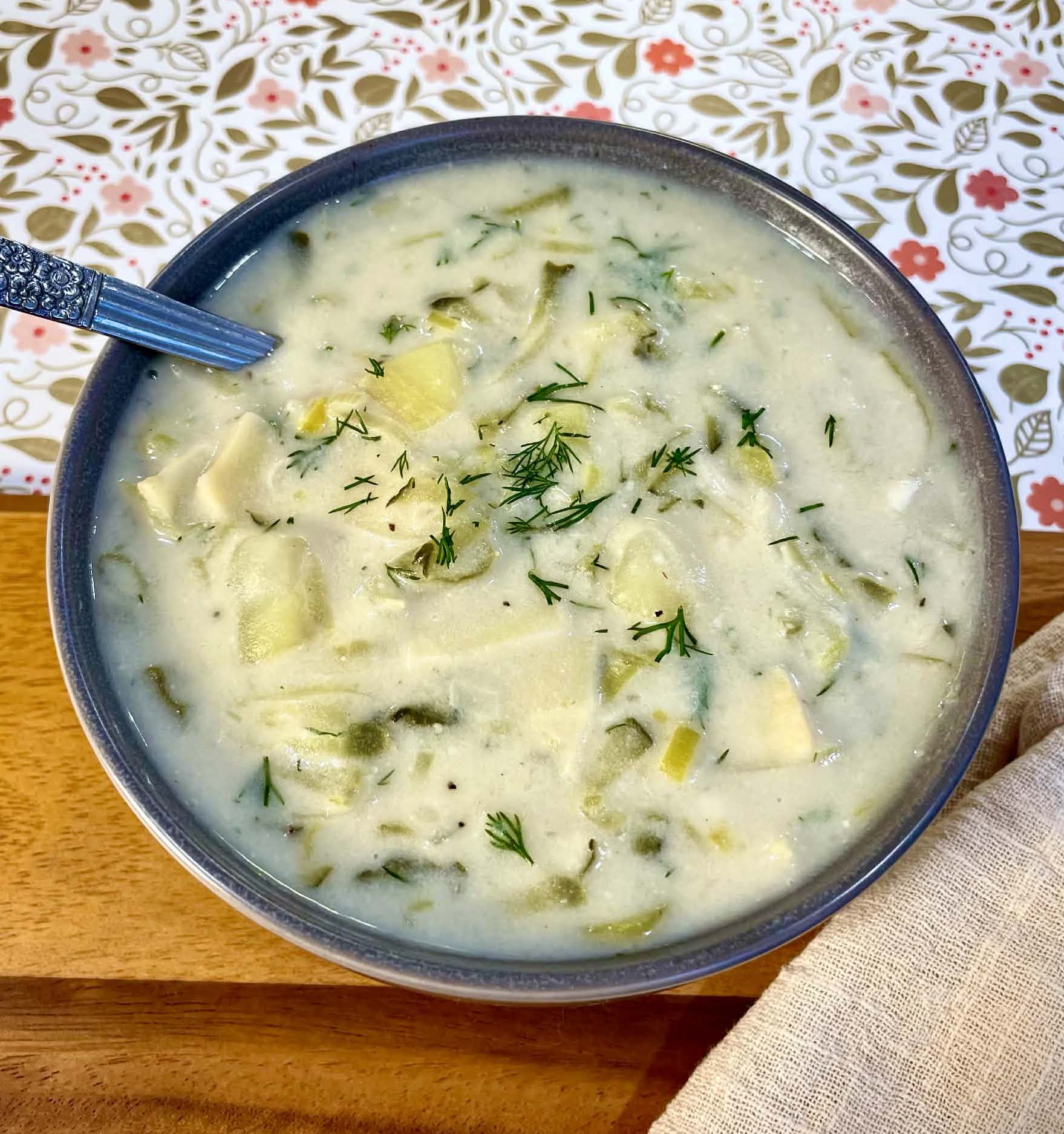
Comfort food is redefined in this hearty soothing plant-based soup with a unique combination of flavors and textures. Subtly sweet parsnips and leeks warmly embrace the savory tang of fermented pickles surrounded by a rich creamy potato base. Fresh dill ties everything together with irresistible Eastern European charm.
WHY I LOVE IT AND YOU MIGHT TOO
It’s not that this soup is an acquired taste. If you like it at all, you’ll probably fall in love at the first sip. That’s what happened to me, anyway. But I suspect that pickle soup is not for everyone and my version is no exception. To enjoy this soup, you probably need to like pickles (a lot). And even if you already like or love pickles, you have to be comfortable with the idea of having pickles in a hot creamy soup. If the thought of a dill pickle soup low key freaks you out, then maybe this recipe is not for you. When I first heard of pickle soup I was intrigued by the concept. But, to be honest, I also had my doubts because I had trouble imagining how it would taste. This soup brings together ingredients I already knew well and loved—pickles, parsnips, leeks, fresh dill, potatoes—and yet the combination is like nothing I’ve ever tasted before. Another odd thing is that I’ve never had or made a soup that feels so addictive. With this soup I have to pace myself the way I pace myself with biscuits or brownies!

GET LACTO-FERMENTED PICKLES
Ideally, pickle soup should be made with lacto-fermented dill pickles. The ingredient label of the pickles you use should not include the word vinegar and will probably list calcium chloride instead. Lacto fermented pickles are widely available in the US but they are not as common as vinegar pickles. You can often find them in the refrigerated section of the grocery store because refrigeration extends the shelf life of this type of pickle, though it is not absolutely necessary in the short run.

WHAT’S DIFFERENT ABOUT MY RECIPE?
I looked at quite a few pickle soup recipes before coming up with my own oil-free whole food plant-based (WFPB) recipe. Most recipes I found online included onions and carrots. I decided to use leeks and parsnips instead just to try something a little different. My research suggests that leeks are a common ingredient and pickle soup and that parsnips are less common but not unheard of, so nothing too out of the ordinary in that. Grating pickles instead of chopping or slicing them is also a popular choice. Where I diverged from most recipes is in cooking the potatoes separately in broth before adding them to the recipe and in the way I prepare the cashew cream that replaces sour cream in traditional Polish pickle soup.
I’d like to explain the method to my pickle soup madness:
- Why cook potatoes separately in vegetable stock? Most recipes I looked at mentioned the need to cook the pickles and the potatoes separately because the acidity in the pickles hardens potatoes prolonging the cooking time, perhaps not allowing them to fully soften at all. Some recipes suggest cooking the pickles separately and adding them to the soup after the potatoes are fully cooked. My way of sidestepping this issue is to boil chopped potatoes in vegetable stock before adding them to the rest of the soup. Cooking the potatoes separately in stock, as opposed to pre-cooking them in some other way, ensures that the potatoes soak up the flavor from the stock while they release their starch into the liquid. There’s an extra pot involved and one more burner is used, or you can do this part ahead of time in the same pot over the same burner setting aside the cooked potatoes in broth to add on later. Either way, it’s worth it. I like to chop my potatoes before doing anything else. Then I can prepare all the other ingredients while the potatoes are cooking.

- Why use pickle brine to make cashew sour cream? I saw several vegan pickle soup recipes that include a homemade vegan ‘sour cream’ with cashews made by blitzing pre-soaked cashews, water or plant milk and lemon juice (or sometimes vinegar). Okay, that is indeed the usual way to make vegan cashew ‘sour cream.’ But since all the pickle soup recipes also add lacto-fermented pickle brine to the soup, I thought it made more sense to skip the lemon juice, use the pickle brine as the only liquid in the cashew sour cream and add the thickening agent into the blender during this step as well. This is a foolproof way to thicken the soup that saves time while staying true to the traditional flavor profile.

BLENDER NEEDED
To make the cashew ‘sour cream’ you will need a blender. As usual, a high speed blender is best in order to get creamier results and get them faster. So long as cashews have had enough time to soak, you can get away with a less powerful blender though you may need to be patient in order to achieve a creamy texture.


SOAKING CASHEWS
For best results, cashews need to be soaked. Soaking cashews will make the cashew ‘sour cream’ creamier. When using a high speed blender you can technically get away with little to no soaking by adding a bit more liquid. The result will not be quite as good and you may need to be patient and process for longer.
Ideal soaking time for cashews is at least two hours if starting with cold water. If you start by pouring boiling water over your cashews, you can get away with a shorter soaking time. Using cashew pieces also reduces the total necessary soaking time. When I know I’ll need soaked cashews the following day, I prefer an overnight soak.
PARSNIPS AND ALTERNATIVES
I love the sweet quirky taste of parsnips and how the texture is just a tiny bit more dense than carrots. But as I mentioned earlier, pickle soup is usually made with carrots. If you live somewhere where parsnips are not available or you prefer not to use them, then carrots are the easiest substitution. A number of other root vegetables would also work in this recipe. I’m thinking turnips, rutabaga, or maybe even white fleshed, not so sweet, sweet potatoes like Hannah.
PREPPING FRESH DILL LEAVES
To prepare fresh dill leaves, first wash the dill thoroughly under cold water to remove any dirt, then gently pat it dry with a paper towel. Next, remove the thick tough stems by pinching off the leaves and discarding the stems. Gather the dill leaves into a pile on a cutting board, and chop them into with a sharp knife. For this soup, I like to chop the dill into pieces that are approximately half an inch long.
EASY OIL FREE SAUTÉING
If you’re not interested in oil-free cooking, go ahead and adapt my method to suit your needs. You can use 1 to 2 tablespoons of your favorite cooking oil or vegan butter to begin the sautéing process instead of vegetable stock or water.
I prefer to use vegetable stock for oil-free sautéing but water works too. Usually, I make my vegetable stock by dissolving low salt stock cubes in water, but you can use any kind of vegetable stock—homemade, liquid concentrate, canned or boxed.
In this particular recipe, parsnips are sautéd separately first in order to develop a layer of caramelized flavor before adding the other vegetables. Begin by heating a scant about 2 to 3 tablespoons of vegetable stock, or water, in a medium to large soup pot or dutch oven over high heat. Keep more water or stock close at hand to use as needed. When the liquid in the pot comes to a rolling boil, reduce heat to medium-high and add the sliced parsnips. Sauté for about 7 minutes or until the parsnips become soft and slightly browned, adding little bits of liquid as needed. Then add the celery, leeks, grated pickles and garlic and sauté for about another 7 minutes. You can continue to add small amounts of liquid if vegetables start to stick to the bottom of the pot, but I find that this particular combination of vegetables releases enough water that adding more liquid isn’t necessary.


PUTTING IT ALL TOGETHER
Once the veggies are sautéd, add the cooked potatoes along with the stock they were cooked in as well as all the remaining vegetable stock to the pot. Bring to a boil, then immediately reduce heat to low and simmer for about 15 minutes. While the burner is still on low, add the cashew, pickle brine and cornstarch cream and cook for 2 or 3 more minutes until the soup thickens. Finally, add fresh dill and black pepper to taste (if using). Taste the soup before serving. If you don’t think it’s salty enough you can add salt or a little more pickle brine before serving


This soup is best served piping hot!
related recipes you’ll love


Vegan Pickle Soup with Leeks and Parsnips Oil-Free

Equipment
- Medium Cooking Pot (3 to 4 quarts is ideal)
- blender (a high speed blender is best)
- Large Cooking Pot (5 to 7 quarts is ideal)
Ingredients
- 6 cups vegetable stock (divided) (low or no sodium preferred)*
- 2 cups peeled, cubed potatoes (approximately 1 pound)
- 2 bay leaves (optional)
- ½ cup raw cashews, measured then soaked**
- ⅔ cup pickle brine from lacto-fermented pickles,*** strained
- 2 Tbsp cornstarch2
- 2 cups parsnips, peeled and thinly sliced into coin size pieces (2 medium-small parsnips)
- 1½ cup thinly sliced leeks, white and light green parts only (2 medium leeks)
- 2 large celery stalks, finely chopped
- 4 to 7 garlic cloves, minced
- 1 cup grated lacto-fermented pickles*** (use large wholes of grater)
- 3 to 4 Tbsp fresh dill leaves, chopped
- black pepper to taste (optional)
Instructions
- Place cubed potatoes, 3 cups of vegetable stock and bay leaves (if using) in a medium size pot. Bring to a boil. Reduce heat and simmer for about 20 minutes or until tender. While the potatoes are cooking, proceed with the next steps of this recipe.
- Place strained pre-soaked cashews, strained pickle brine and cornstarch in the bowl of a blender and process until smooth. Set aside.
- Pour 2 to 3 tablespoons of vegetable stock into a large pot and bring to a rolling boil over high heat, keeping more stock close at hand. Add sliced parsnips to pot, lower heat to medium-high, and sauté for about 7 minutes until parsnips become tender and slightly golden, adding a little bit of stock at a time, as needed, to keep parsnips from burning and/or sticking.
- To the parsnips in the pot, add the leeks, celery, shredded pickles and garlic. Sauté for an additional 7 minutes until all vegetables are tender. You can continue to add little bits of stock if necessary to prevent sticking, but it's usually not necessary.
- Add the potatoes along with the vegetable stock they were cooked in (remove bay leaves first if used) and all remaining vegetable stock to the large pot. Bring to a boil. Reduce heat and simmer for 15 minutes.
- Add creamy cashew, pickle brine, and cornstarch mixture and cook another 2 or 3 minutes to thicken.
- Stir in chopped dill leaves and season with black pepper if desired.
- Taste soup to check the saltiness level. Add salt if you think it needs it, or you can add a bit more pickle brine instead.
- Serve hot!


Leave a Reply