

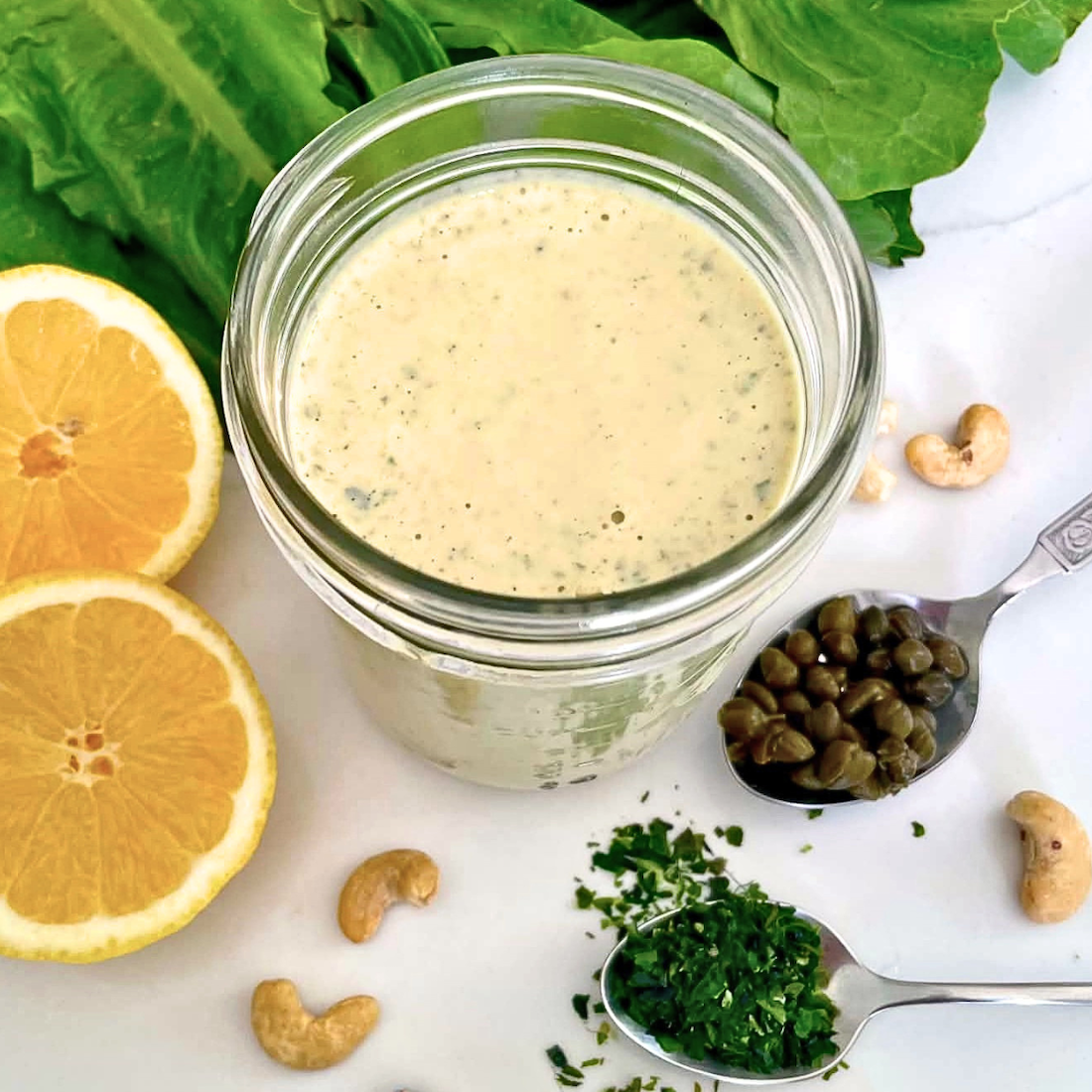
A bold deeply savory lemony cashew-based no oil vegan Caesar dressing that’s rich and complex. Tangy artichoke brine is the star of the show here, its built-in brininess boosted by capers. Nori magnifies the umami flavor notes while adding an oceany flavor that echoes Chef Caesar Cardini’s classic recipe.

WHY I LOVE IT
Caesar salad was a favorite of mine before going vegan and it remained a favorite after I became vegan and mostly whole food plant-based no oil (WFPBNO). There are many great plant-based Caesar dressing recipes out there but my inspiration comes primarily from Brandi Doming’s lovely oil-free recipe featured in her blog, The Vegan 8. I’m not sure who came up with the idea of using water-based artichoke brine to make plant-based Caesar dressing, but Brandi’s recipe was where I first encountered the concept. My oil-free version was designed to meet my own maximalist sensibilities. I wanted the pungent impact of fresh garlic, more brininess, a yellower color and some of that subtle fishiness that traditional Caesar salads get from anchovies. Naturally I ended up with more ingredients but, in my view, more can be better. Since coming up with this recipe, I’ve been making it on repeat because I’m almost never not in the mood for a healthy nourishing plant-based Caesar salad made with homemade croutons, my parmesan-like seed and nut topping, roasted chickpeas or seasoned roasted chick’n soy curls.
HIGH SPEED BLENDER RECOMMENDED
For a reliably smooth silky dressing that comes together quickly, a high speed blender is strongly recommended. High speed blenders are blenders with a minimum of 1,000 watts (20,000+ RPM). Although this dressing can be made with a less powerful blender, it’s probably not going to be as smooth even with cashews that have had an adequate soak.
SOURCING ARTICHOKE BRINE
The artichoke brine I used for this recipe came from one 8.5 ounce of Trader Joe’s whole artichoke hearts. Although the brand doesn’t matter, for this recipe to work it’s essential that your artichoke brine be water-based rather than oil-based. To access enough brine I strain the artichoke hearts using a fine mesh strainer. Then I gently squeeze the artichoke hearts to release more brine because it’s in the nature of artichoke hearts to trap a lot of liquid between leafy folds. You will not need the artichoke hearts for this recipe, so save them in the fridge or freezer and use them later. Artichoke hearts are a wonderful ingredient to have around for salads, sandwiches or to use as a pizza topping. Two of my all time favorite recipes call for water-packed artichoke hearts, spinach artichoke lasagna and artichoke hummus.

GREEN OLIVE BRINE ALTERNATIVE
If you prefer you can also make this recipe using the brine from green olives packed in water-based brine. The flavor will be olive-like instead of having echoes of artichoke flavor. It’s really a matter of preference and your own convenience. Again, please make sure that your olive brine is water-based, not oil-based.
PRE-SOAKING CASHEWS
For best results, cashews need to be soaked. Adequate soaking time makes for a creamier dressing. With a powerful high speed blender you can technically get away with little to no soaking by adding a bit more liquid. The result may not be quite as good, and you’ll need to process the dressing a little bit longer.
The ideal soaking time for raw cashews is at least two hours when starting with cold water. But if you start by pouring boiling water over the cashews, you can get away with a shorter soaking time of 20 minutes or less. Using cashew pieces instead of whole cashews helps reduce the necessary soaking time. I prefer to use cashew pieces because I think they’re better for making creamy things and they’re usually less expensive.
Any amount of soaking is better than no soaking. When I know I’ll need soaked cashews the following day, I prefer an overnight soak.
NORI FLAKES
Nori flakes are dehydrated, crumbled pieces of edible seaweed, the same seaweed used for sushi rolls. Most Asian grocery stores stock nori flakes and you can also order them online. Another option is to make your own nori flakes by crumpling or cutting up nori that you buy in sheets. Since the nori flake in this recipe will be pulsed into the dressing using a blender, you don’t even need to get your nori crumpled up super fine because the blender will do it for you.
DON’T FEAR CAPERS
I know that capers are a controversial ingredient that many people dislike. But if you’re a caper hater, I’m urging you to bury the axe, set aside your anxieties, basically do whatever you have to do and try them in this recipe because the final product doesn’t have that odd intense quality that whole capers have. Context is important!
TURMERIC FOR COLOR
Powdered turmeric is a versatile health-forward ingredient with antioxidant and anti-inflammatory properties. In this recipe, I’m using turmeric as a natural way to give this dressing a subtle yellow color that’s nearly identical to that of traditional caesar dressing made with eggs. The amount used barely impacts the flavor, but does add a nice little something. In any case, food enters our consciousness through the eyes first so I think color’s important.
TWO-STEP BLITZING
This dressing is processed in two simple steps. During the first, longer, step all the ingredients are processed together except for the nori flakes and the capers. The idea is not to over-process the nori and capers while you’re making an emulsified creamy base out of the other ingredients. Don’t get me wrong, if you blitzed everything together all at once the dressing would still taste good, but it would end up being more green than yellow.
I have a small powerful blender that gets the mixture quite creamy after one minute of processing. Every blender is different and yours might be faster or slower than this. Then I add the nori flakes and capers, pulsing three or four times until I see little green specs instead of larger chunks.


SERVE OR STORE
You can use this dressing immediately or you can store it in an airtight refrigerated container for up to five days. Refrigerating your dressing will make it a little bit thicker, but it’s delicious either way.

related recipes you’ll love


Oil-Free Vegan Caesar Dressing (artichoke brine and cashews)

Equipment
- small bowl (for soaking cashews)
- Mesh Strainer (for straining cashews)
- High Speed Blender (1000 watts or more preferred)
Ingredients
- ⅔ cup raw unsalted cashews (whole or pieces)
- ¾ cup artichoke brine from a can* (water-based, no oil!)
- 4 Tbsp freshly squeezed lemon juice
- 2 to 3 garlic cloves** (think 2 to 3 teaspoons worth)
- 1 Tbsp Dijon mustard
- ⅛ to ¼ tsp black pepper
- ¼ tsp ground turmeric
- ¼ tsp salt (optional because there's already salt from the artichoke brine and capers)
- 1 Tbsp capers
- 2 tsp nori flakes***
Instructions
Pre-Soak Cashews
- Place raw cashews in a small bowl, cover with boiling water and let soak for at least 20 minutes if using whole cashes or at least 15 minutes if using pieces. Cashews can also be soaked in cold water for at least 2 hours or overnight. Read more about soaking cashews in the main recipe text.
- Strain soaked cashews discarding the water used for soaking.
Blitzing Phase 1
- Place strained cashews, artichoke brine, lemon juice, garlic cloves, Dijon mustard, black pepper, ground turmeric and salt (if using) in the bowl of a high speed blender.
- Process until smooth and creamy.
Blitzing Phase 2
- Add the capers and nori flakes to the creamy mixture in the blender.
- Pulse 3 or 4 quick times until the capers become small specs. Be careful not to over pulse.
Serve or Store
- Serve immediately or store in a sealed refrigerated container for up to 5 days.
- Note that this dressing gets thicker (in a good way) after it's been refrigerated for several hours.


Leave a Reply