
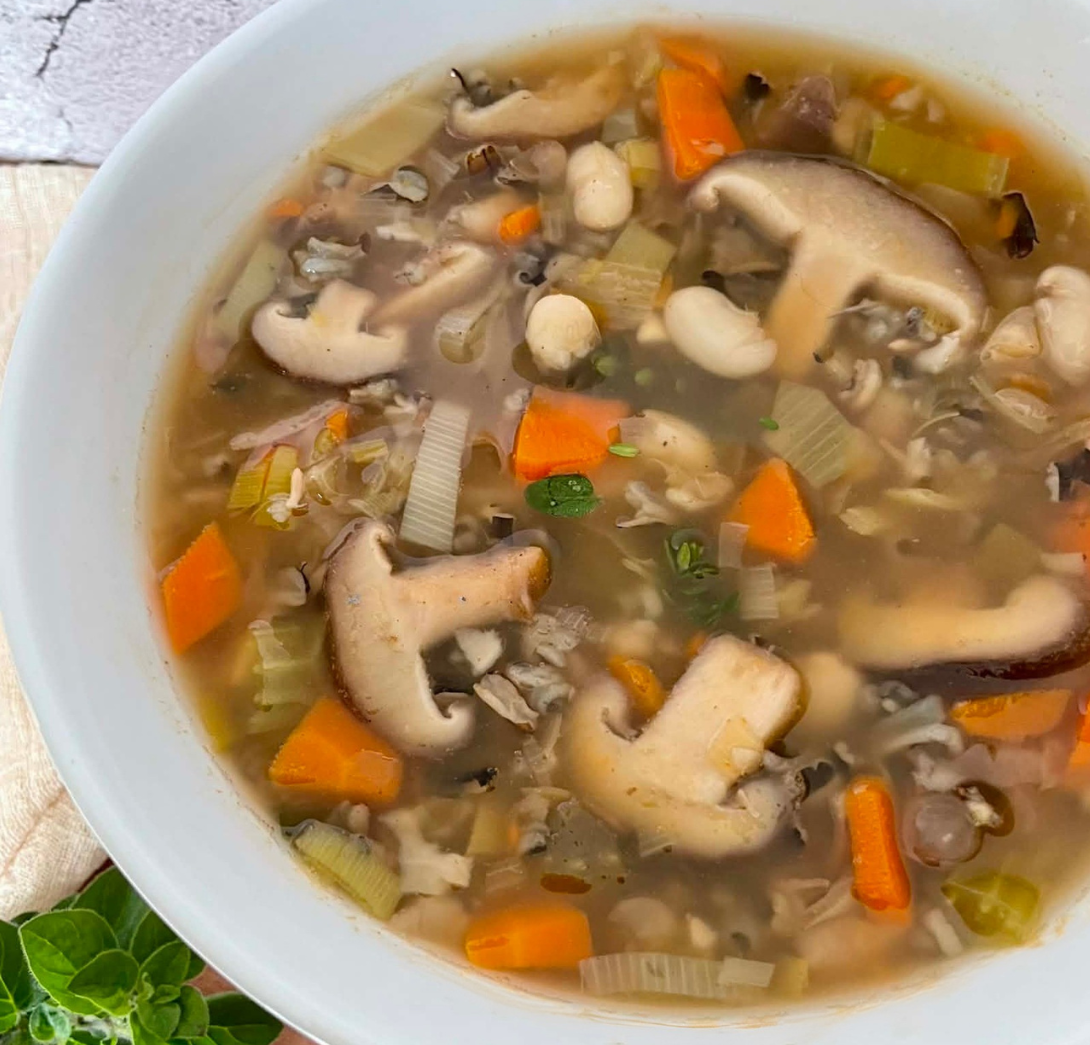
Earthy nutty wild rice and umami-packed shiitake mushrooms pair exceptionally well in this whole food plant-based oil-free soup that embodies the spirit of vegan fusion. Ingredients from Asia, Europe and North America along with a seasoning mix inspired by Middle Eastern cuisine seamlessly unite in a delightfully nourishing mélange.
DREAMING UP THIS SOUP
I’m pretty sure I loved wild rice the first time I tasted it when I was around eight. Finding out that it isn’t even rice but rather an entirely different species made me love it even more. This dark nutrient-rich grass seed that happens to be the only grain indigenous to North America pairs well with many foods, but mushrooms (of any kind) are my favorite wild rice pairing of all. Given my strong foodie feelings about wild rice and mushrooms, I set out to create a rich plant-based soup that would make the most of this dark and complex duo. Shiitake mushrooms are a good choice for this soup because, like wild rice, they’re a little fancy and highly nourishing, but other mushrooms also work well. Leeks are my favorite allium for soups and thought they’d be good here. I added white beans because I try to eat legumes every day. Actually, there’s more to the bean thing. White beans provide a pleasing optic contrast while also boosting protein and making the texture more hearty and satisfying. Trying to stay whole food plant-based (WFPB) adherent has meant that I’ve mostly given up using coconut milk as a way to thicken soups. By adding beans and using an immersion blender to partially blitz the soup I create a bit of creaminess without needing to add saturated fat. There’s a distinctive Middle Eastern vibe to the combination of seasonings I used in this soup. The combination is warm and deep, but not overpowering. First I’d decided to use sumac, a bright citrusy spice that reminds me of dried apricots. After that everything that came to mind set me in the general culinary direction of the Levant/ Eastern Mediterranean.


BEAN OPTIONS
I used home-cooked Great Northern beans for the batch of soup featured in this recipe. My suggestion is to stick with white beans, but aside from that, almost any kind will do and using strained canned beans is fine. I think that butter beans, aka large lima beans, would be particularly good.
PRE-COOK THE WILD RICE
Cooking wild rice separately before adding it to a soup is a good idea for several reasons. Wild rice absorbs a great deal of liquid when it’s being cooked and it cooks more quickly and reliably when it’s not surrounded by other ingredients. Then there’s the abundance of pigments that are released into the cooking liquid, pigments that may overwhelm the look and flavor of other ingredients in the soup. For this recipe I use a pasta method where the wild rice is cooked in a large amount of vegetable stock and then strained. It’s the best of both worlds because the grain absorbs the flavor from the stock, but the pigment from the grain doesn’t go into the soup. Pre-cooking doesn’t add a lot of time to the recipe prep because there’s plenty to do while the wild rice cooks. I suggest getting the wild rice going before you do anything else then, while it’s cooking, you can wash and chop all the vegetables, measure your spices and start sautéing.
A WORD ABOUT CELERY LEAVES
I like to remind my fellow foodies to use and enjoy celery leaves whenever possible. I made celery leaves optional in this recipe because I know that people who live in the US can have trouble finding celery with leaves on it. That’s a shame because celery leaves are considered an herb in their own right. They impart a fresh intense celery taste that’s a little different than the flavor of celery stalks. To use celery leaves in this recipe, separate them from the stalk, chop and set them aside. You will add them at the very end of the recipe.

TOMATO POWDER OR PASTE
A relatively new-to-me ingredient I’ve come to love is tomato powder which is tomato paste in a dry powdery form that can be stored in your pantry almost indefinitely. There is a subtle but distinct umami quality to the flavor. Tomato powder contributes a note of tang that is less recognizably tomato-y than tomato paste. You can use tomato paste instead of tomato powder for this soup, and in other recipes, by substituting approximately double the amount of tomato paste for the tomato powder. Aside from enjoying the convenience, I prefer the more subtle flavor profile of tomato powder in many of my recipes. To learn more about tomato powder check out my tomato powder ingredient spotlight post.

EASY OIL-FREE SAUTÉING WITH WATER
If you want to use oil to sauté the vegetables, go right ahead. But because my blog focuses on whole food plant-based adherent recipes, I avoid highly processed calorie-dense ingredients like oil as much as possible. Oil-free sautéing is a great way to cut back on the amount of oil in your life and it’s surprisingly easy once you get the hang of it.
Although I often sauté with vegetable stock, for this recipe, I prefer to use water to sauté the vegetables in this recipe because there’s already a lot of vegetable stock going into the soup. You need to keep about one cup of water close at hand while you’re sautéing the vegetables that will be used a little bit at a time.
Begin by heating approximately 2 tablespoons of water in a large pot over high heat. When the water in the pot comes to a rolling boil, add the chopped carrots. Bring the temperature of the burner down to medium-high and sauté the carrots for 10 to 15 minutes or until they become tender, adding little bits of water (less than a tablespoon at a time) as needed to keep them from burning as they inevitably begin to stick to the pot. That momentary sticking where you immediately deglaze with liquid to prevent burning is what you want. It means that caramelization is taking place, and caramelization adds layers of flavor. To the carrots in the saucepan, add the leeks, mushrooms, celery and garlic, and sauté an additional 7 to 10 minutes until the mushrooms release most of their water. Continue to add small amounts of water whenever necessary to prevent sticking and burning. You probably won’t need to add very much water during this phase because the mushrooms and celery release a substantial amount of moisture as they cook. Finally you’ll sauté the seasonings into the veggies, stirring for another minute or less.


CREATING THE SOUP
Once all the vegetables are cooked and seasoned add the vegetable stock, cooked rice and cooked beans. Bring the contents of the pot to a boil then reduce heat and simmer, preferably covered, for 10 minutes. When the 10 minutes are up, or almost up, you can add the chopped celery leaves if using.

A VERY PARTIAL BLITZ
Now it’s time to create some creaminess by partially processing the soup. An immersion blender is the easiest way to do this. Dip the immersion blender into the soup and pulse two or three times, breaking up the ingredients just enough so that the broth becomes more opaque. If you don’t have an immersion blender you can use a regular blender or food processor for this step by removing 1/2 to 3/4 cup of the content of the soup with a slotted spoon so that you’re not removing much liquid, and then placing the portion you’ve removed in the bowl of a your regular blender or food processor, pulsing two to four times to create a thickening mixture which gets poured back into the soup.


SUBSTITUTIONS & VARIATIONS
These are some substitutions and variations that I know for sure work because I’ve actually tried them. As always, feel free to use my recipes as a jumping off point for your own culinary creations!
- Use Another Kind of Mushroom: I’ve made this soup with white button mushrooms and with cremini mushrooms and both versions were delicious. You could also try oyster mushrooms or a combination of mushrooms.
- Sub Carrots with Winter Squash: Using peeled chopped fleshy winter squash (think butternut or kuri) instead of carrots makes this soup a little sweeter, but the orange pop of color maintains the optics. You can also use a combination of carrots and squash to create even more complexity.
- Use Ground Marjoram: I love marjoram in this soup! You can either sub the thyme with one teaspoon of ground marjoram, or keep the thyme and add a half teaspoon of ground marjoram.
- Use Ras El Hanout: A couple of teaspoons of ras el hanout, a delicious spice blend from Northern Africa, could be used in place of all of the seasonings except for the thyme and tomato powder (or paste).
- Sub Celery Leaves with Fresh Parsley: If you don’t have celery leaves, but you still want some fresh leafy goodness to get into this soup, you can use a handful of chopped fresh parsley leaves as a substitute.
- Add a Pinch of Nutmeg or Mace: I often do this. It’s a lovely way to evoke a sense of creaminess through flavor.
related recipe’s you’ll love


Wild Rice Shiitake Mushroom Soup with White Beans Oil-Free

Equipment
- 1 Medium Saucepan (2.5 to 3 quarts is ideal)
- mesh strainer or fine colander (for straining wild rice)
- medium-large saucepan or dutch oven (5 to 6 quarts is ideal)
- Wooden Spoon
- Immersion Blender (or use a slotted spoon and regular blender or food processor)
Ingredients
- ½ cup wild rice
- 8 cups vegetable stock (divided)
- 2 large carrots, finely chopped (about 1½ cup, chopped)
- 2 cups sliced leeks, white and light green parts only (cut in quarters lengthwise, then sliced)
- 6 oz shiitake mushrooms, sliced (about 2 cups sliced mushrooms, packed)
- 4 to 7 garlic cloves, minced
- 1 large celery stalk, finely chopped (a scant ½ cup, chopped)
- 1 handful celery leaves, chopped (optional)
- 1½ cup cooked white beans, strained (canned beans are fine)
- 1½ tsp sumac
- 1½ tsp tomato powder* (or sub with 1 Tbsp tomato paste)
- 1 tsp ground cumin
- 1 tsp dried thyme
- 1 tsp smoked paprika
- ¼ tsp allspice
- ½ tsp salt (or to taste)
- ¼ tsp black pepper (or to taste)
Instructions
Cook the Wild Rice
- Start this process before doing anything else. While the wild rice is cooking you can wash and chop the vegetables, etc.
- Place 3 cups of vegetable stock in a medium small sauce pan over high heat and bring to a boil.
- Rinse the wild rice thoroughly in cold water to remove dust using a mesh strainer or fine colander to strain away dirty water.
- Add rinsed rice to boiling vegetable stock. Reduce heat and simmer for 40 minutes or until grains pop open and curl back revealing cream colored center.
- Strain away excess broth and set aside.
Sauté Vegetables (oil-free method)
- Place a medium-large saucepan or dutch oven over medium-high heat and place a cup of water close by.
- Pour approximately 2 tablespoons of water into the medium-large sauce pan. When the water comes to a rolling boil, add the chopped carrots.
- Sauté carrots for 10 to 15 minutes, stirring constantly with a wooden spoon and adding small amounts of water (no more than a table spoon at a time) as needed to prevent sticking and burning. Momentary sticking followed by deglazing with water is part of the process and means that the carrots are getting slightly caramelized. Keep going until carrots are tender.
- To the carrots in the saucepan add the leeks, mushrooms, celery, and garlic. Continue to sauté, stirring constantly and adding tiny amounts of water as needed to prevent sticking and burning for 7 to 10 minutes until mushrooms have released most of their water (refer to photos in the main text if you want to see what this process looks like). You probably will not need to add very much water, if any, during this step because the mushrooms and the celery release a lot of liquid.
- Add the sumac, tomato powder (or tomato paste), cumin, smoked paprika, dried thyme, allspice, salt and black pepper and sauté for another 30 seconds to a minute.
Create the Soup
- To the seasoned vegetables in the pot add the remaining 5 cups of vegetable stock, cooked white beans and cooked wild rice.
- Bring to a boil then reduce heat and simmer for 10 minutes.
- Towards the end of the 10 minute simmer, add the chopped celery leaves (if using).
Partial Blitzing
- Turn off heat.
- Dip an immersion blender into the soup and pulse 2 or 3 times to break down some of the ingredients and thicken the broth. There's no ideal amount of processing here, but I think that less is more because this soup should be mostly chunky, not smooth and creamy.
- If you don't have an immersion blender and are using a regular blender or food processor for this step, use a slotted spoon to remove about ½ to ¾ cup of the content of the soup (veggies, wild rice and beans) with a slotted spoon so that you're removing as little liquid as possible. Place the portion you've removed in the bowl of a blender or food processor and pulse 2 to 4 times to create a thickening mixture. Pour the processed mixture back into the soup and stir.
Adjust Thickness and Seasonings
- If the soup is thicker than you want it to be, you can add water or vegetable stock, a little at a time, until you achieve the desired consistency.
- Taste the soup and decide if you need to add more seasonings.
Serve Hot or Store
- This soup should be enjoyed hot and makes 4 meal-size servings, or up to 8 small servings.
- If you want to save this soup for later, cook it completely and refrigerate in a covered or sealed container for up to 5 days. I have not tried freezing this soup so I'm not sure what it would do to the texture.



Leave a Reply