
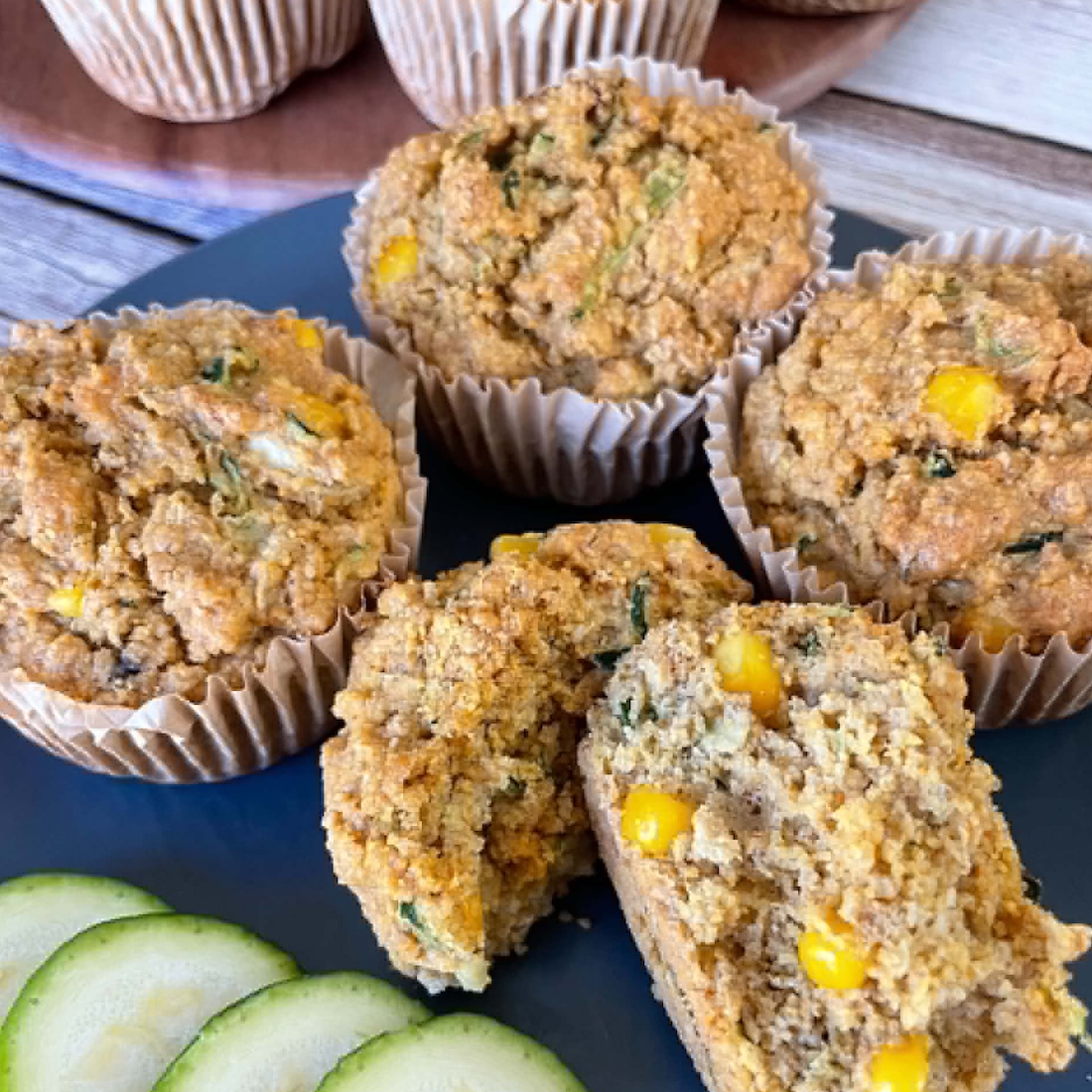
These gluten-free cornbread zucchini muffins are the perfect savory plant-based bake. Corn and tahini dominate the warm satisfying flavor profile. Grated zucchini creates a moist, interesting texture while boosting nutrients. Lovely as a light breakfast or a nourishing side.

WHOLESOME AND INCLUSIVE
I try to include a variety of gluten-free baking recipes in my blog because I want my little corner of the internet to feel inclusive. Designing a gluten-free vegan cornbread muffin made from whole grains and containing no added oil was a bit challenging. After several tries I think I nailed it. Because my blog focuses on whole food plant-based no oil recipes, I wanted my readers to have the option of using paper muffin liners instead of having to grease a pan. It turns out that this was impossible to do without an adequate amount of fat in the batter. By using a modest amount of nutrient-dense tahini I was able to create a tasty tender muffin that pulls away from a parchment paper liner. Tahini also compliments the other flavors beautifully and helps create a rich golden texture on the muffin tops.
DOES TAHINI COUNT AS OIL?
Tahini is a paste made of whole ground sesame seeds. Many of us know it as a staple in the traditional cuisine of West Asian and Northern Africa, but historically it has also been used throughout the Mediterranean and parts of Asia. Today tahini is popular all over the world. Used in moderation, tahini is considered acceptable in whole food plant-based (WFPB) recipes. Unlike oils which are extractions removed from whole plant foods and thus lower in nutrients, tahini is made from the whole sesame seed and is thus nutrient dense. In fact, you could say that tahini is a nutritional powerhouse. Unlike oil, it’s a great source of calcium and contains protein, fiber, selenium, and more. Check the label and try to always get tahini that doesn’t have added oil though, because some brands do.
Although tahini is a versatile ingredient that can do many different things, in this particular recipe I am primarily using it as a whole food substitute for oil. As I’ve already mentioned, I needed to increase the fat ratio in the batter to keep the muffins from sticking to paper liners. To my delight, the result has been a uniquely tasty satisfying muffin with a delicate buttery crumb.
AQUAFABA AS AN OIL SUBSTITUTE
The viscous, starchy, liquid left over after cooking beans is called aquafaba. I usually get my aquafaba from canned chickpeas. Instead of throwing away the aquafaba surrounding canned chickpeas, I save it for other uses. There are many great ways to use aquafaba in plant-based cooking or any kind of cooking where the goal is to rely less on oil and/or eggs. You can make meringues with aquafaba by whipping them up with sugar. Aquafaba can be a good oil substitute in salad dressing and some forms of baking. In this recipe, aquafaba is working as a partial oil substitute and to help with binding. Because these muffins are gluten-free they need some amount of fat for the recipe to work. As I’ve discussed above, that’s where the tahini comes in. But by using a quarter cup of aquafaba, I was able to get away with using a relatively small amount of tahini, also a quarter cup, keeping the fat content of these muffins relatively low.
YOU CAN MAKE YOUR OWN OAT FLOUR
If you want to use store bought oat flour, that’s fine. But making your own oat flour is easy, fast and economical. All you need is rolled oats and a food processor or high speed blender. Place your oats in your processor or blender and pulse until you get flour. Don’t over process your oat flour because it will become sticky and not work as well in your recipes. As far as flour texture goes, oat flour that’s a little coarse works better for most types of baking. Don’t try to make too much at a time. Small batches, no more than a cup and a half at a time, are better. I usually only process the amount I’m about to use in a recipe. One cup of oats makes approximately one cup of oat flour. Keep in mind that pure oats are gluten-free, but since oats can become contaminated with gluten during processing or harvesting, choose a brand of oats or oat flour marked gluten-free if you need to be 100% gluten-free for health reasons.


CHOOSING YOUR CORNMEAL
These muffins can be made with medium or finely ground cornmeal. I used finely ground cornmeal which I ordered online because the only finely ground cornmeal I could find at local stores wasn’t whole grain like I prefer. Medium ground cornmeal will result in a slightly gritty, more rustic muffin. Being whole food plant-based (WFPB) compliant as much as possible, means choosing grains that haven’t had the germ removed and are more coarsely ground because less grinding means less processing. But for most types of baking, coarse grind cornmeal is just too gritty, so I don’t recommend it.
FRESH AND FROZEN VEGGIES
You need fresh zucchini for this recipe so that you can grate it. The corn kernels can be fresh, frozen or even canned if you’re careful to squeeze out all excess liquid. When I use fresh corn kernels I cook them first with my favorite in the husk oven-baked method. You could also use uncooked fresh corn kernels though I haven’t tried that myself.
CREATING THE MUFFIN BATTER
Start by combining the wet ingredients and whisking in the tahini. You don’t need to create a perfectly smooth mixture. This step eventually helps the tahini spread out more evenly into the batter.

Then, in a large mixing bowl, combine the dry ingredients. Note that although the ground flaxseed works as a binder in this recipe, it’s treated as one of the dry ingredients instead of being pre-mixed with water to form a ‘flax egg.’ In my opinion that step is not necessary.


Now add the mixture of dry ingredients folding it into the batter until the wet ingredients are fully incorporated. Gluten-free batters benefit from extra mixing, so it’s a good idea to spend a little time creating a moist thick batter before adding the corn kernels and zucchini, what I like to call the chunky ingredients.


Lastly, the corn kernels and grated zucchini are folded into the batter until evenly distributed.


SCOOP AND BAKE
Paper baking cups make being oil-free easy. I like to use a large soup spoon to scoop my batter into 2-1/2 inch paper baking cups which line a standard muffin pan. Ideally all the muffins get the exact same amount of batter. In my oven, baking time is 20 minutes at 400 ℉. When muffins are done they should look golden on top and feel firm.


SUBSTITUTIONS AND VARIATIONS
I’m not going to suggest as many variations as usual for this recipe because getting the right texture for these muffins while preventing them from sticking too much to the liners was a challenge. That being said, here are a few variations that I’m sure would work.
- Replace the Corn Kernels with Chopped Peppers: Instead of corn kernels you could use fresh peppers chopped into small pieces. Red or green bell peppers would work well and provide a nice color contrast to the batter. If you prefer a spicier, more distinct flavor, fresh jalapeños or Anaheim peppers would also be good. I would recommend against using canned, pre-cooked or roasted peppers because they would change the moisture balance of the batter.
- Chili Powder as a Spice Alternative: You can replace the cumin, smoked paprika and onion powder with 2 to 2-½ teaspoons of chili powder.
- Use Lemon Juice or Another Kind of Vinegar: Instead of apple cider vinegar you can use lemon juice, white wine vinegar or any other kind of light vinegar.
- Leave Out the Nutritional Yeast: I included nutritional yeast in this recipe because I think it adds a slightly cheesy umami that benefits many savory recipes, but it’s not essentia.
related recipes you’ll love


Zucchini Cornbread Muffins Vegan Gluten-Free WFPB

Equipment
- Standard Muffin Pan
- 12 Paper Baking Cups, 2½ inch
- small mixing bowl that holds at least 2 cups (for combining wet ingredients)
- whisk or fork (for combining wet ingredients)
- Large Mixing Bowl
- silicone spatula
- large spoon, optional (for scooping batter)
Ingredients
Wet Ingredients
- 1 cup plant milk (plain unsweetened, any type is fine)
- ⅓ cup aquafaba
- 1 Tbsp apple cider vinegar (lemon juice or another light vinegar are also ok)
- ¼ cup tahini
Dry Ingredients
- 1¼ cup oat flour (read about making your own in the main text)
- 1 cup cornmeal, fine or medium grind
- 2 Tbsp nutritional yeast (optional)
- 1 Tbsp ground flaxseed
- 1 Tbsp baking powder
- ½ tsp baking soda
- ½ tsp salt
- 1 tsp ground cumin
- 1 tsp smoked paprika (regular paprika is ok too)
- ½ tsp onion powder
- ⅛ to ¼ tsp cayenne pepper (optional)
Chunky Ingredients
- 1 to 1¼ cup grated fresh zucchini*
- ½ cup corn kernels**
Instructions
Prepare Oven and Pan
- Line a standard muffin pan with twelve 2½ inch paper baking cups. Parchment baking cups work best.
- Preheat oven to 400 ℉.
Combine Wet Ingredients
- Place plant milk, aquafaba and vinegar in a small mixing bowl.
- Add tahini to wet ingredients and whisk together (you can use a fork instead of a whisk if you prefer). The mixture does not have to be perfectly smooth. The idea is just to break up the tahini a bit.
- Set aside.
Create the Muffin Batter
- Combine all dry ingredients in a large mixing bowl.
- Pour combined wet ingredients over the dry ingredients in the large bowl and fold together using a silicone cake spatula until wet ingredients are thoroughly incorporated and a medium thick batter forms. Because this is a gluten-free batter, a little extra mixing is beneficial so don't be afraid to over-mix.
- Now add the grated zucchini and corn kernels, folding until all the chunky bits are evenly distributed throughout the batter.
Scoop and Bake
- Spoon batter into muffin pan lined with paper muffin cups. I like using a large spoon for this.
- Bake at 400 ℉ for 20 minutes. When muffins are done they should look toasty golden on top.
Cool and Serve
- When the muffins come out of the oven it's best to leave them in the muffin pan to cool completely before serving. This is the best way to minimize having the bottom layer of the muffins sticking to the baking cups.

Leave a Reply