
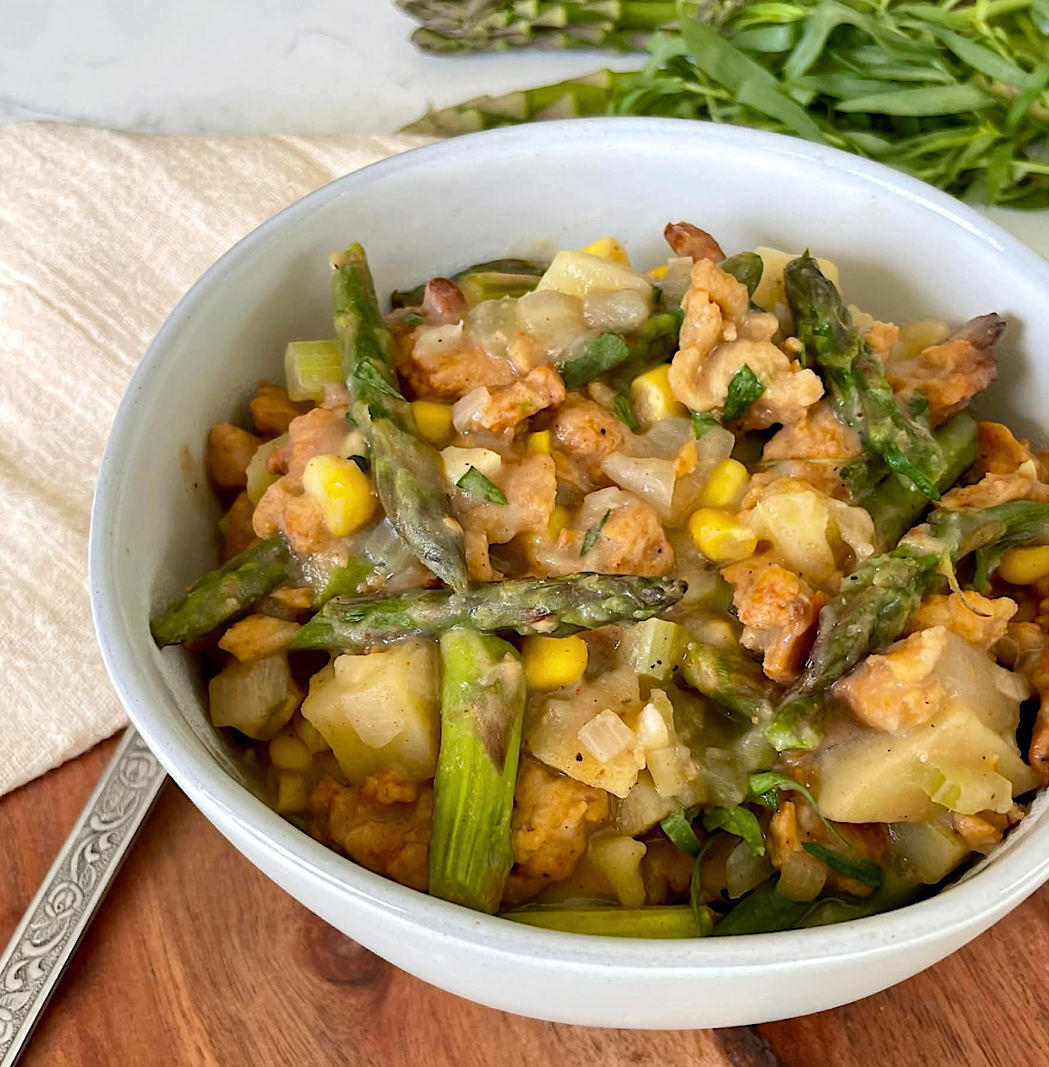
A balanced hearty umami-packed stew harnessing the subtle sweetness of corn and fresh asparagus. Soy curl chick’n strips make this vegan main course meaty and filling, satisfying the occasional yearning for Old World European flavor. Blended cannellini beans add a layer of creamy plant-powered protein.

THE PERFECT PLANT-BASED SPRING STEW
In this dish, asparagus provides a delicate balance to the hearty soy curl chick’n strips and creamy potatoes. Corn kernels accentuate the subtle sweetness of asparagus creating a satisfying and balanced main dish experience. I used tarragon because I think it’s the perfect spring herb to use with asparagus. Shallots make things slightly sweeter and a little fancier, though they can easily be swapped out for white or yellow onions. Blitzing cooked cannellini beans creates creaminess while boosting the nutrient content of the stew, making it satisfying in a stick-to-your ribs comforting way.
SOY CURL LOVE
Convenient, affordable, nourishing and minimally processed, soy curls are my new favorite meat-like ingredient. If your approach to whole food plant-based (WFPB) adherence includes foods like tofu and TVP, then there’s no reason not to embrace soy curls as well. Depending on the recipe, soy curls can be so similar to chicken or pork strips that even omnivores might be fooled. But like many other ingredients, their awesomeness is heavily dependent on how they’re prepared. In this recipe I think I managed to optimize the flavor and texture of soy curls without using added oils.

CELEBRATING ASPARAGUS
Asparagus isn’t just my favorite spring vegetable, or even my favorite green vegetable, it’s my favorite vegetable of all time! And I know I’m not alone. Even if the weather outside is still bitterly cold, seeing fresh locally grown asparagus in the produce section of the grocery store means that spring has arrived. I wonder if it’s the anticipation of warmer weather ahead that makes this sturdy versatile vegetable so uniquely appealing.
MUSHROOM POWDER UMAMI
Mushrooms can contribute a depth of umami flavor that we usually associate with animal foods. I love cooking with fresh and dried mushrooms. I’m even a fairly skilled mushroom hunter. But it’s often the case that I want to bring some umami mushroom goodness into my cooking without introducing the texture of mushrooms. And that’s where culinary mushroom powders come in.
Almost any culinary culinary mushroom powder would be good in this recipe, but shiitake mushroom powder is my favorite because it’s the best at subtly enhancing the umami impact of the recipe. It’s worth investing in mushroom powders as pantry staples. Using them sparingly, adding little bits here and there in your cooking, can take savory vegan dishes to another level by seamlessly and inconspicuously blending in with other flavors.
SOAKING FLAVOR INTO SOY CURLS
Technically, soy curls can be soaked in any liquid, including water. But since the soaking stage is the first opportunity to add flavor, I strongly recommend making the most of this opportunity. Broth with a little bit of coconut or liquid aminos creates a perfect soaking liquid the soy curls in this recipe. I used Not Chick’N vegetable broth and coconut aminos, but any type of plant-based broth is fine, and you can substitute aminos for soy sauce or tamari. Although it may sound a bit wasteful, it’s important to discard the liquid used for soaking the soy curls instead of trying to repurpose it. That’s because soaking removes some of the raw soy taste that detracts from the overall flavor of the recipe.


CORNSTARCH FOR TEXTURE & THICKNESS
In this recipe, cornstarch is used to enhance texture in several ways. After soaking and squeezing out the excess liquid, the soy curls are dredged in cornstarch before they’re roasted. This thin layer of cornstarch helps the soy curls keep their shape once they go into the stew. As the soy curls roast, the cornstarch on the soy curls gets toasty, creating a kind of dry roux which will also eventually thicken the stew. I also add a little cornstarch to the cannellini bean and wine (or broth) blend as a way to thicken the stew.


PRE-ROASTING FOR CARAMELIZATION
Caramelization is essential to building deep umami flavor. Pre-roasting vegetables and other ingredients before they go into a stew is a great way to create caramelization without the need for added oil. For this recipe, I decided to roast the soy curls and asparagus together before adding them to the stew. The optimum roasting temperature for pre-soaked soy curls is similar to the temperature I use for oven-roasting asparagus, so I decided to roast them together. After dredging the soy curls in with cornstarch they are placed over a parchment paper lined baking pan along with chopped fresh asparagus and tossed with seasonings. The 20 to 25 minutes it takes to roast these ingredients doesn’t add to the total time required for this recipe because there’s plenty of prep and cooking to do during hands-off roasting time.


EASY OIL-FREE SAUTÉING
Oil-free sautéing is a great way to cut back on the amount of oil in your life and it’s surprisingly easy, economical, and starts feeling like second nature once you get used to it. If you want to use oil to sauté the vegetables, go right ahead. But because my blog focuses on whole food plant-based adherent recipes, I avoid highly processed calorie-dense ingredients like oil as much as possible.
In this recipe, the diced shallots are sautéd separately first in order to develop a layer of caramelized flavor before adding the other vegetables. Begin by heating a scant about 2 tablespoons of vegetable broth in a medium to large soup pot or dutch oven over high heat. Keep more vegetable broth close at hand to use as needed. When the broth in the pot comes to a rolling boil, reduce heat to medium-high and add the sliced onion. Sauté for 5 to 7 minutes, or until the shallots start to become translucent, adding little bits of broth as needed to prevent sticking. Then add the celery and garlic and sauté for another 4 minutes. You can continue to add small amounts of broth if vegetables start to stick to the bottom of the pot. Now add the cubed potatoes, corn kernels, shiitake mushroom powder and nutmeg (if using) and sauté for another couple of minutes. This process ensures that you’ve built a layer of caramelization before covering the vegetables with broth and start the simmering phase in which flavors blend, the potatoes and the corn release some of their creamy starches, and eventually the potatoes become tender.


PUTTING IT ALL TOGETHER
It’s important to make sure that all the potatoes are cooked all the way through before you go on to the final steps of this recipe. Then it’s time to add the smoothie made by blitzing the cannellini beans with cornstarch and white wine (or broth). By bringing the temperature of this mix back up to a gentle boil, the beans and cornstarch create a creamy thickness. At this point the roasted soy curls and asparagus are added and stirred in until all ingredients are warm. Fresh tarragon goes in last so as to maximize its flavor impact. If you decide to use dry tarragon, it’s best to add it earlier in the cooking process.


TARRAGON ALTERNATIVES
Asparagus and tarragon are in season at the same time and taste amazing together. But if you don’t like, or can’t get, fresh or dry tarragon you can use another herb instead. Thyme would be my top pick as a tarragon substitute in this recipe, though I’d use a little less than the quantity suggested for tarragon. Start with 2 tablespoons of fresh thyme leaves or 2 teaspoons dry, see how that tastes and decide if you want to add more. Other good options are sage, parsley or some sort of poultry seasoning blend.
related recipes you’ll love


Asparagus Chick’n Corn Stew Oil-Free Vegan (made with soy curls)

Equipment
- Medium mixing bowl
- large mesh strainer
- large baking sheet
- Parchment Paper
- medium or large cooking pot (6 to 7 quarts is ideal)
- blender (a food processor would also work)
Ingredients
- 4 oz soy curls (about 2 cups)
- 5 to 6 cups vegetable broth* (divided)
- 1 Tbsp liquid or coconut aminos (or sub with soy sauce or tamari)
- 2 Tbsp cornstarch (divided)
- 1 lb fresh asparagus, trimmed and cut in 1½ to 2 inch pieces) (weight prior to trimming)
- 1 tsp smoked paprika
- 1 tsp salt (divided)
- ½ tsp garlic powder
- ¼ tsp black pepper (or to taste)
- 1 cup shallots, diced (or sub with white or yellow onion)
- 1 large stalk celery, finely chopped (about ¾ cup)
- 1 Tbsp minced fresh garlic
- 1 large potato, cubed** (about 1½ cups cubed potato is ideal)
- 1 cup corn kernels (fresh or frozen)
- 1 Tbsp shiitake mushroom powder
- 1 pinch nutmeg or mace (optional)
- 1½ cup cooked cannellini beans, strained (a 15.5 can is fine)
- ¾ cup white wine (optional, you can use broth instead)
- 3 Tbsp fresh tarragon leaves, chopped (or use 1 Tbsp dry tarragon***)
Instructions
Prepare Soy Curls
- Place 2 cups of vegetable broth and the liquid or coconut aminos in a medium size bowl.
- Add the soy curls to the bowl and soak for 10 to 15 minutes.
- Use a large mesh strainer to strain the soy curls, discarding the soaking liquid.
- Squeeze out excess liquid from the soy curls by squeezing them with your hands or by pressing on them with a large spatula or spoon while they're still in the strainer.
Roast Soy Curls and Asparagus
- Preheat oven to 400 ℉ (200 ℃) and line a large baking sheet with parchment paper.
- Place strained, squeezed out, soy curls on the parchment lined baking sheet. Sprinkle the soy curls with 1 tablespoon of cornstarch and tossed until the soy curls are evenly coated.
- Add chopped fresh asparagus to the soy curls on the baking pan.
- Sprinkle soy curls and asparagus with smoked paprika, garlic powder, pepper and ½ teaspoon of salt. Toss so that seasonings are evenly distributed. The soy curls and asparagus get tossed together during this step. Arrange the soy curls and asparagus so that they cover the parchment paper in a single layer.
- Place the baking sheet in the preheated 400 ℉ (200 ℃) oven and roast for 20 to 25 minutes, tossing them once halfway through. Note that although you shouldn’t burn the soy curls, don’t worry if they become dry and crunchy, later they’ll soften up when they’re added to the stew and that crunchy dryness will actually create a better texture.
- Remove the baking sheet the from oven and set aside.
Oil-Free Sauté Vegetables
- Pour 2 tablespoons of vegetable broth into a medium to large pot and bring to a rolling boil over high heat, keeping more broth close at hand. Add sliced diced shallots to pot, lower heat to medium-high, and sauté for 5 to 7 minutes until shallots start to become translucent, adding no more than a couple of teaspoons of broth at a time, as needed, to keep shallots from burning and/or sticking.
- To the shallots in the pot, add the celery and minced fresh garlic. Sauté for an additional 4 minutes. Continue to add little bits of broth as necessary to prevent sticking.
- To the vegetables in the pot, add cubed potatoes, corn kernels, shiitake mushroom powder and nutmeg (if using). Sauté for 2 to 3 more minutes, adding a tiny bit more broth if needed to prevent sticking.
Simmering Phase
- Cover the vegetables in the pot with 2 cups of vegetable broth. Bring to a boil then reduce heat and simmer uncovered for about 20 minutes until all the cubed potatoes are soft and tender.
Process the Cannellini Beans
- While the veggies are simmering, place strained cannellini beans, 1 tablespoon of cornstarch and ¾ of white wine or vegetable broth in a blender or food processor and process until smooth. This should take less than a minute in a high speed blender but could take longer in a conventional blender or food processor.
Putting Together the Stew
- Once the potatoes are tender, stir the cannellini bean blend into the pot.
- Raise the heat and bring to a boil. Allow the contents of the pot to boil 1 to 2 to allow the mixture to thicken.
- Turn off the heat and add the roasted seasoned asparagus and soy curls to the pot. Gently stir so that the asparagus and soy curls are heated.
- Stir in the fresh chopped tarragon leaves.
Suggestions for Serving and Storing
- This stew should be served piping hot.
- To save for later, allow the stew to cool and store in the fridge sealed a in sealed container. Freezing this stew would probably work but I have not tried it.
- Although this stew is a balanced and filling stand-alone main dish it also pairs nicely with rustic whole grain bread or my Easy WFPB Spelt Biscuits.


Leave a Reply