
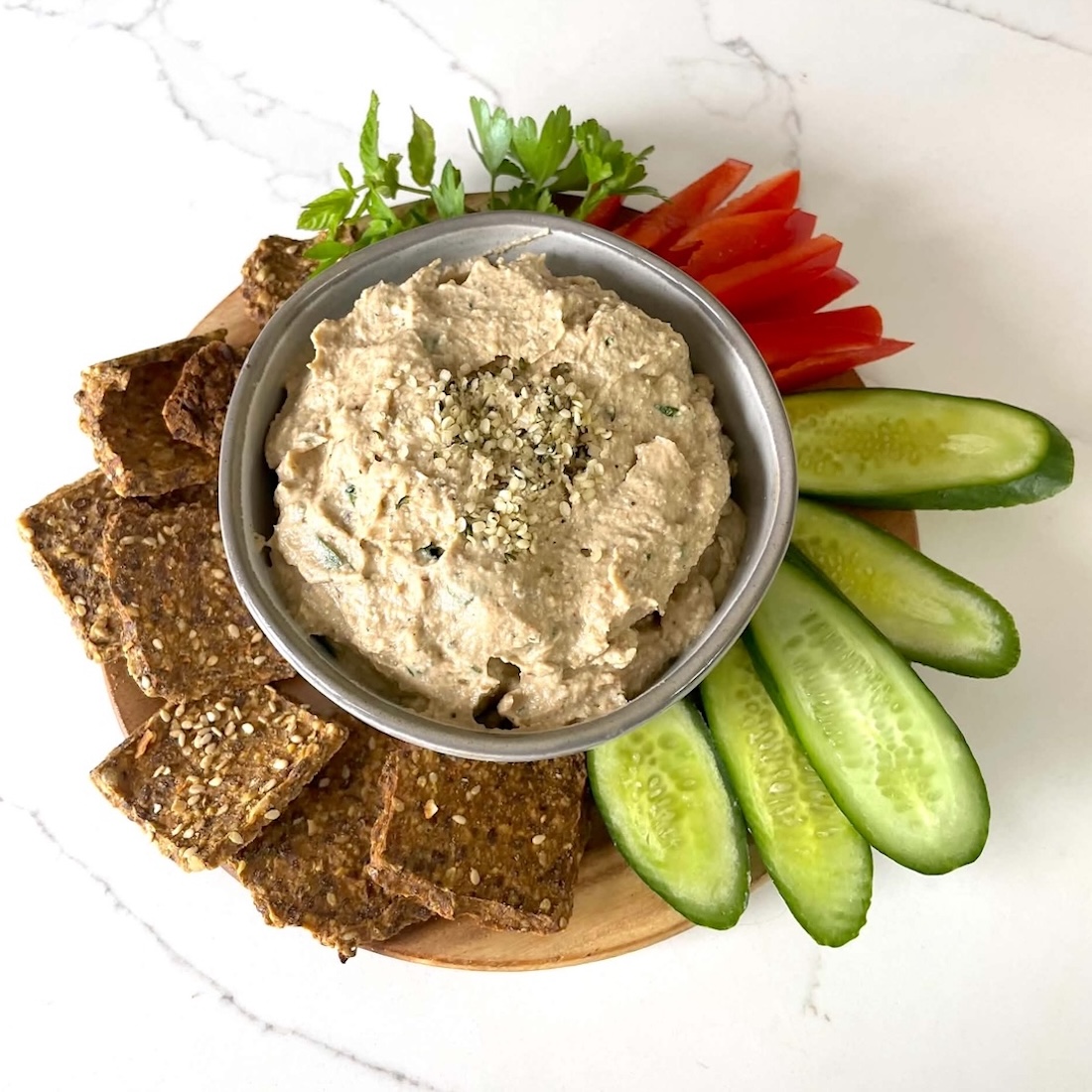
Baba ganoush is a smokey eggplant dip originating in the Levantine region of the Eastern Mediterranean. My version is free of added oil and unapologetically modernized with a protein boost from silken tofu and hemp hearts. The added protein sources create a thicker consistency that’s perfect for sandwiches and wraps.

MY BABA GANOUSH LOVE 💚
My love for baba ganoush goes way back to my first encounter with West Asian cuisine. The first time I tried it was also the first time I tried hummus. The two dips were served side by side at a restaurant in Rehoboth Beach, Delaware called The Camel’s Hump (I think it’s still there). I’m old, so this was when Americans viewed both hummus and baba ganoush as exotic, if they’d heard of them at all. Now hummus has become a world renown dish that’s a vegan staple and almost as popular with omnivores. Meanwhile, baba ganoush has trailed well behind hummus in popularity. From the start, I liked baba ganoush every bit as much as hummus. They are culinary cousins with many similarities.
BRIDGING THE POPULARITY GAP
I can think of several reasons why, over time, hummus became significantly more popular than baba ganoush. One is that if you’re using canned chickpeas, hummus is faster and easier to make. Even if you’re working with dry chickpeas that take a long time to cook, you’re still not fussing with a perishable seasonal vegetable like eggplant. Another reason hummus is more popular, especially with vegans, is that it has a lot more protein. But baba ganoush is its own yummy thing, fluffier and smokier than hummus. In this recipe I’ve partially bridge the protein gap between hummus and baba ganoush by adding a little bit of silken tofu and high fiber protein-packed hemp hearts. I knew that some variations of baba ganoush include yogurt, and my hunch was that silken tofu would work as well as yogurt while increasing the nutrient density in a way that’s got yogurt beat. Since baba ganoush already has a slightly lumpy rustic texture from the seeds in the eggplant pulp, adding hemp seeds also works well.
GO FRESH OR GO HOME
I don’t like sounding inflexible, but if you can’t get your hands on quality fresh eggplants, baba ganoush isn’t worth the effort. Look for firm eggplants with smooth, tight, glossy satiny skins. Older eggplants tend to be less firm, dull and even wrinkly. The problem with older eggplants is that they’re more bitter even after careful prepping.
TAHINI IS A WHOLE PLANT FOOD
Tahini is a paste made of whole ground sesame seeds. The flavor profile of baba ganoush wouldn’t be the same without it, especially in a recipe like this one where I’ve already deviated from tradition by excluding olive oil and adding non-traditional ingredients. Due to its high fat content, people sometimes have trouble understanding that tahini is an acceptable ingredient in a whole food plant-based (WFPB) adherent diet. But having fat doesn’t keep something from being a whole plant food. Avocados are a whole plant food, as are nuts and fresh coconut. All of these foods are also high in fat. If your approach to WFPB strictly excludes oil, check the label because some brands of tahini do add extra oil as a stabilizer.
CRUCIAL EGGPLANT PREP
Before creating this recipe I took a deep dive into the vast world of online baba ganoush recipes. The truth is that most of these recipes are wonderful, whether traditional or new fangled like my own. Bad recipes for baba ganoush are recipes that don’t explain how to properly roast and strain the eggplants, or don’t call for roasted eggplants at all like a recipe I saw that listed steamed eggplant as the main ingredient. Proper roasting makes eggplants soft and smoky which is crucial for a good baba ganoush. Straining removes the excess liquid which is often bitter. Now that you know the secret to what makes for a good recipe, feel free to find a different one. It’s all mostly good baba ganoush advice out there.
OVEN ROASTING EGGPLANTS
Roasting eggplants for baba ganoush is easy. It just takes a little time. Simply cut eggplants in half lengthwise, place them on a parchment paper lined baking sheet cut side down and poke the skin of each eggplant several times with a fork. Bake your eggplants at 425 °F (220 °C) for at least 40 minutes until the skin looks quite wrinkly and the flesh is very soft. If your eggplants haven’t reached this point after 40 minutes, pop them back in the oven and check again every five minutes. If the oven temperature is set right the roasting could take up to 55 minutes max.


SCOOPING AND STRAINING
When eggplant has been properly roasted, the flesh can be easily scooped out away from the peels. Ideally, I like to wait until the eggplant halves have cooled down a bit and are easy to handle before starting to work on scooping out the flesh, about ten minutes. Straining away excess, often bitter, liquid is also important. I do this by placing the eggplant flesh in a fine mesh strainer or any strainer lined with a cheese cloth. The strainer is placed over a bowl in order to catch the liquid. This liquid gets discarded, but I just don’t want it all over my kitchen counter. You can press the eggplant flesh with a spoon or your fingers to help release the liquid. If you’re using a cheesecloth you can wrap it up like a bag and gently squeeze.


BLITZ AND FOLD
Now the process gets easy peasy. The strained eggplant is placed in a food processor or blender along with all the other ingredients except for the parsley. Then you process until a smooth dip forms, pushing the sides down as needed until all ingredients are incorporated. The chopped parsley leaves are folded in with a spatula. If you’re using a food processor, you can do the folding in the food processor bowl itself by carefully removing the blades first.


SUBSTITUTIONS & VARIATIONS
- You can use cumin or ground coriander seed instead of, or in addition to, smoked paprika.
- Fresh mint leaves are a classic alternative to fresh parsley in baba ganoush. You could also use a combination of both.
- Plain unsweetened plant based yogurt is the perfect substitute for silken tofu. Your baba ganoush will be a little less dense and contain less protein, but if you use soy yogurt the overall protein content won’t be dramatically different.
- Sesame seeds are a good substitute for hemp hearts though you are reducing the overall protein content.
related recipes you’ll love


Oil-Free Baba Ganoush with Tofu and Hemp Heart Protein

Equipment
- Baking Sheet
- Parchment Paper
- large spoon (for scooping eggplants)
- fine mesh strainer
- Cheesecloth (optional, good if you don't have a strainer with a fine mesh)
- Medium mixing bowl
- food processor or blender
- silicone spatula
Ingredients
- 2 eggplants,* medium sized (approximately 1 lb each)
- ½ cup silken tofu
- ¼ cup tahini
- 3 Tbsp fresh lemon juice
- 3 Tbsp hemp hearts
- 2 to 3 garlic cloves (approximately 2 to 3 teaspoons worth)
- ½ tsp smoked paprika
- ¼ to ½ tsp salt
- ¼ cup fresh parsley leaves, finely chopped
Instructions
Prepare the Eggplant
- Preheat oven to 425 ℉ (220 ℃) and line a baking sheet with parchment paper.
- Cut each eggplant in half lengthwise. Using the tip of a fork or pointed knife, poke several holes in the skin of each eggplant half to allow steam to escape.
- Place eggplant halves skin side up on the parchment paper lined baking sheet and bake for about 40 minutes or until the skins are wrinkled and the flesh of the eggplant is very soft.
- Remove eggplant halves from the oven and let them cool for a bit so that they're easy to handle, about 10 minutes. Use a large spoon to scoop out the soft flesh of the eggplants, leaving the peels behind.
- Place scooped eggplant flesh in a fine mesh strainer, or a colander lined with cheesecloth, to drain off the excess liquid. I place my strainer over a mixing bowl to catch the dripping liquid.
Process All Ingredients Except Parsley
- Place strained eggplant flesh and all other ingredients except for the parsley leaves in a bowl of a food processor or blender and process until smooth. You will need to push down the sides once or twice with a silicone spatula so that all ingredients are incorporated.
Fold In Chopped Parsley Leaves
- If you're using a blender you will have to transfer the baba ganoush into a mixing bowl in order to fold in the parsley. If you're using a food processor you can either transfer it into a mixing bowl, or carefully remove the blades of your food processor and fold the parsley in the food processor bowl.
Serve or Store
- Baba ganoush can be served immediately or stored in a sealed container in the fridge for up to four days.


Leave a Reply