
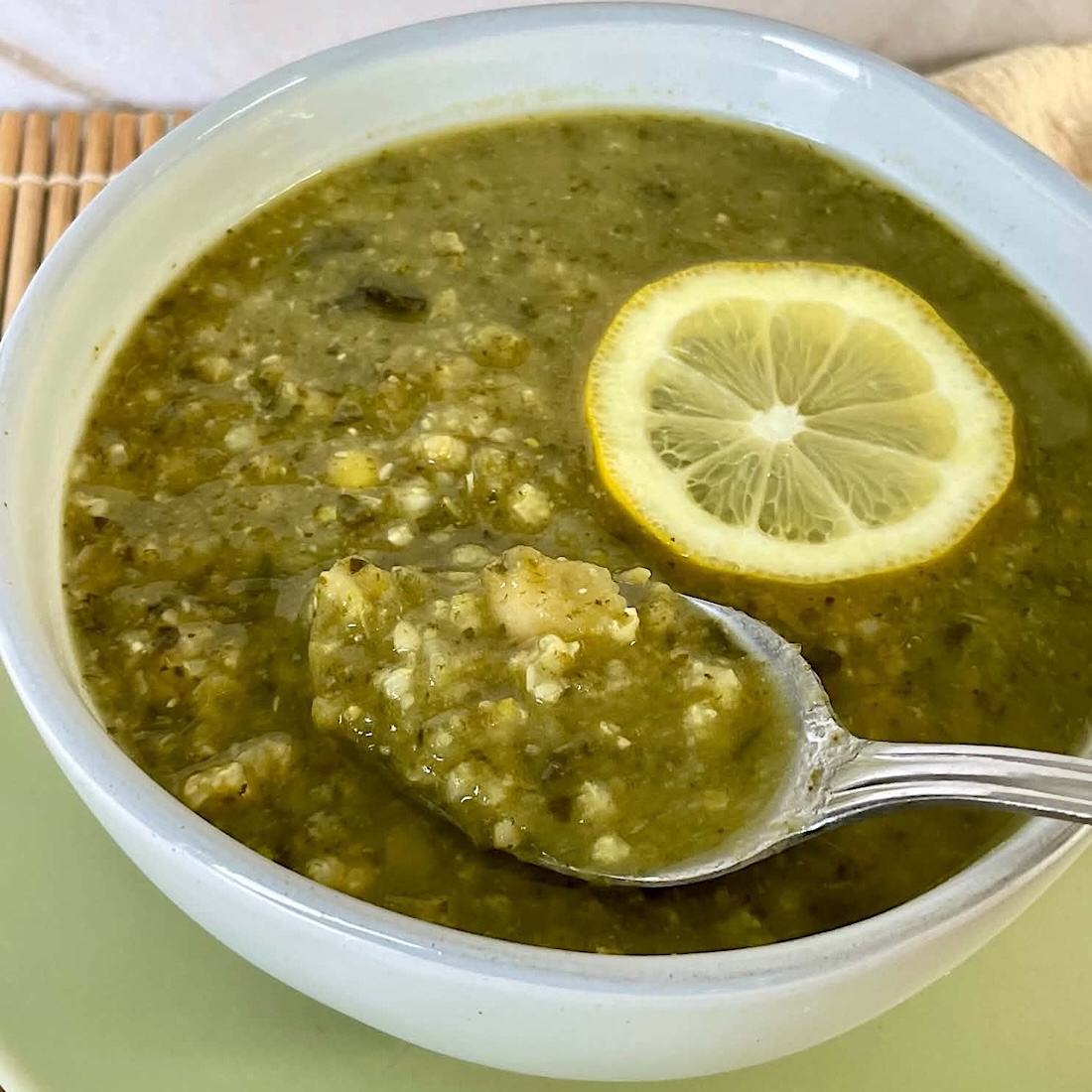
When you need a truly healthy soup that feels like a meal, nothing beats this hearty balanced recipe. Delicately sweet zucchini pairs perfectly with earthy kale and millet. White beans and frozen peas add creaminess while boosting protein. This recipe is plant powered, gluten-free and made without added oil.

THIS SOUP’S ORIGIN STORY
I’m a green creamy soup person. Over the years I’ve come to trust the fact that so long as I have the foundation, onions, garlic, an herb or two and hopefully some celery, I can turn almost any combination of green vegetables into a tasty soup. All it takes is a bit of chopping followed by some patient sautéing and a minute or two of immersion blender blitzing. Adding white beans and/or peas is one favorite ways to boost nutrient density and create creaminess in these types of soups. This particular soup originated from one of my green creamy soup experiments, an experiment which resulted in a pretty good soup that was certainly healthy. Then on the soup’s second day, I happened to have batch cooked some millet for an entirely different purpose and decided to add it to my reheated soup. Tasting this otherwise pleasant but unremarkable soup with the addition of millet was a eureka moment. I knew I could turn this almost accidental combination of ingredients into an exceptionally delicious, nourishing and unique whole food plant-based soup recipe. The next time I made it, I decided to go easy on the blitzing phase, creating a soup that’s both chunky and a little creamy.
FROZEN VEGGIES ARE GREAT FOR SOUPS
Frozen vegetables are perfect for soups. The downside of frozen vegetables is that they’re mushier than fresh because ice crystals inevitably rupture the cell wall of the plant. In soups this is not an issue because everything’s going to get mushy anyway. I specify frozen kale and peas in this recipe, but really it could be made exclusively with frozen veggies. Since I live alone, I often freeze sliced celery to have in hand for soups, same with zucchini.
ANY WHITE BEAN WORKS
This soup can be made with fresh, canned or cooked then frozen beans. Cannellini beans are ideal and a strained 15.5 ounce can is the right amount. Other great options are navy beans, great northern, butter beans or an heirloom variety like Marcella beans.
MILLET: A GLUTEN-FREE ANCIENT GRAIN
Millet is probably the most ancient of all the ancient grains. It’s extremely nourishing and mostly underappreciated. There are many different millets but the one most commonly used to feed humans is pearl millet. All millets have a mild pleasant taste. I did not list cooking instructions because the cooking time depends on the type of millet being used and whether it’s been pre-soaked. I like to cover my millet with boiling water and let it soak for 30 to 60 minutes before cooking. The soaking makes it cook a lot faster, improves the bioavailability of nutrients and makes it more digestible.
IMMERSION BLENDER RECOMMENDED
In order to create a partially creamy texture, you’ll need some sort of blender or food processor. An immersion blender is especially good for soups because it saves you the trouble of taking cooked ingredients out of the pot and into another container for processing. You could make this soup using a stand alone blender or food processor instead by letting the veggies cool down a bit before transferring them into a conventional blender and food processor for partial blitzing.
OPTIONAL SHIITAKE MUSHROOM POWDER
Almost any culinary mushroom powder would add enhance the umami flavor in this recipe. I strongly recommend and always prefer to use shiitake mushroom powder because it’s the most subtle and thus the most versatile. It’s worth investing in mushroom powders as pantry staples. Using them sparingly, adding little bits here and there in your cooking, can take savory plant-based dishes to another level. Mushroom powders can blend in with other flavors inconspicuously when used in moderation. Shiitake mushroom powder happens to be the least conspicuous and the best at highlighting the umami notes present in adjacent ingredients.
CELERY LEAVES ARE FABULOUS
Celery leaves are underappreciated and seldom used in American home cooking. In fact, most of them are chopped off from the celery before getting to store shelves. This is too bad because celery leaves are packed with flavor and nutrients. I think they add great flavor to soups, so if you have them, use them! When I shop for celery I always try to find the heads with the most leaves. You can also find celery sold in individual stalks with a few leaves on them. I use celery leaves for soups, sauces and add them to smoothies.
EASY PEASY OIL-FREE SAUTÉING
Although this is a soup where eventually most of the ingredients are simmered together for an extended amount of time, I still like to sauté the onions, celery, garlic and zucchini first in order to build flavor through caramelization. And yes, caramelization still happens when you’re not using oil for sautéing.
I like using vegetable broth for sautéing but water works perfectly well too. Usually, I make my vegetable broth by dissolving low sodium bouillon cubes in water, but you can use any kind of vegetable broth—homemade, liquid concentrate, canned or boxed.
Begin by heating about 2 tablespoons of vegetable broth, or water, in a large pot over high heat. Keep more liquid close at hand to use as needed. When the liquid in the pot comes to a rolling boil, reduce heat to medium-high and add chopped onions. Sauté for 5 to 6 minutes or until the onions become translucent, adding little bits of liquid as needed. Then add the garlic, celery and zucchini and sauté for another 5 to 7 minutes, adding liquid if necessary, until the zucchini gets soft and tender.


SIMMERING PHASE
Now you’re ready to add four cups of vegetable broth, kale, peas, beans, nutritional yeast, thyme and shiitake mushroom powder (if using). Bring to a boil then reduce heat and simmer for at least another 15 minutes or until the zucchini is very soft. Finally add the parsley and/or celery leaves (if using) and stir them in until they wilt.

PROCESSING AND FINAL PREP
The nice thing about an immersion blender is that you can process your soup while it’s still warm and inside the pot. Simply dip the blender into the pot and process until some generalized creaminess begins to happen but there’s still a bit of chunkiness going on. This process is not an exact science but it doesn’t take a lot of skill either. If you end up processing more than you intended, the soup will still be good, just more creamy and less chunky. For a brief discussion on how to use a food processor or conventional blender instead, scroll back up to the section titled IMMERSION BLENDER RECOMMENDED. Once the blitzing is done, mix in the cooked millet and the juice of half a lemon. I’m leaving the amount of cooked millet in the recipe a bit vague (1-½ to 2 cups) because it depends on personal preference. Add more vegetable broth or water, a little at a time, if the soup is too thick. Soup thickness is also up to you. Taste the soup and decide if you want more lemon juice before adding salt and pepper to taste.


related recipes you’ll love


Kale Zucchini Soup with Millet WFPB

Equipment
- large pot or dutch oven (5 to 7 quarts is ideal)
- mug or small pitcher (to hold vegetable broth during oil-free sautéing)
- Immersion Blender (a stand alone blender or food processor would also work)
Ingredients
- 3 low sodium vegetable bouillon cubes or 6 cups of of broth*
- 1 yellow or white onion chopped
- 2 celery stalks (medium size), sliced to ¼ inch pieces (about 1 cup sliced)
- 3 to 5 garlic cloves, peeled and quartered
- 2 medium-small zucchini or 1 large, sliced (you need about 1½ to 2 cups sliced zucchini)
- 8 oz frozen kale
- 1½ cup cooked white beans, strained (you can use 15.5 oz can of strained beans such as cannellini)
- 1 cup frozen peas
- 2 Tbsp nutritional yeast
- 1 tsp dried thyme
- 1 tsp shiitake mushroom powder optional
- 1 or 2 handfuls parsley and/or celery leaves optional
- 2 to 4 Tbsp fresh lemon juice (the juice of ½ to 1 lemon)
- 1½ to 2 cups cooked millet
Instructions
Create Vegetable Broth from Bouillon Cubes (if applicable)
- If you're starting with vegetable bouillon cubes instead of vegetable broth, dissolve bouillon cubes in 6 cups of warm or hot water.
Oil-Free Vegetable Sautéing
- Fill a mug or small pitcher with one cup of the vegetable broth or water and set it close to the stove to use during sautéing.
- Pour about 2 tablespoons of vegetable broth into a large pot and bring to a rolling boil over high heat.
- Add onions to pot, lower heat to medium-high, and sauté for 5 to 6 minutes until onions become translucent, adding very small amounts of liquid as needed, to keep onions from burning and sticking, about 1 or 2 teaspoons at a time.
- Add zucchini, celery and garlic to the onions in the pot and sauté for another 5 to 7 minutes until zucchini becomes soft, adding very small amounts of liquid as needed to prevent burning and/ or sticking.
Simmering Phase
- To the sautéd vegetables in the pot add 4 cups of vegetable broth, kale, beans, peas, nutritional yeast, thyme and shiitake mushroom powder (if using).
- Bring contents of the pot to a boil then reduce heat to low and simmer for at least 15 minutes until the zucchini becomes very soft. You can cover the pot if you like.
- If using fresh parsley and/or celery leaves, now’s the time to stir them into the soup. Wait for leaves to wilt before going onto the next step.
Blitzing Phase
- If Using an Immersion Blender: Leave heat on low and dip the immersion blender into soup and process until you achieve a slightly creamy, slightly chunky, texture. Refer to the main recipe text to see photos of how I do it.
- If Using a Food Processor or a Regular Blender: For this method you’ll have to turn off the stove and remove the vegetables from the broth and partially process them outside the pot, then return them to the pot and reheat before going on to the next step.
Final Steps
- To the partially blended soup add the cooked millet and about 2 tablespoons of lemon juice (or the juice of ½ lemon) and stir over low heat until thoroughly combined and heated through.
- If the soup seems too thick add more vegetable broth or water, a little at a time until you achieve the consistency you prefer.
- When the thickness is to your liking, taste the soup and decide if you want to add more lemon juice. Once the acidity is also to your liking, you can season with salt and pepper to taste.
Serve and Store
- This soup should be served piping hot.
- You can also keep this soup in a sealed refrigerated container for up to 4 or 5 days or freeze it for up to 5 months.


Leave a Reply