
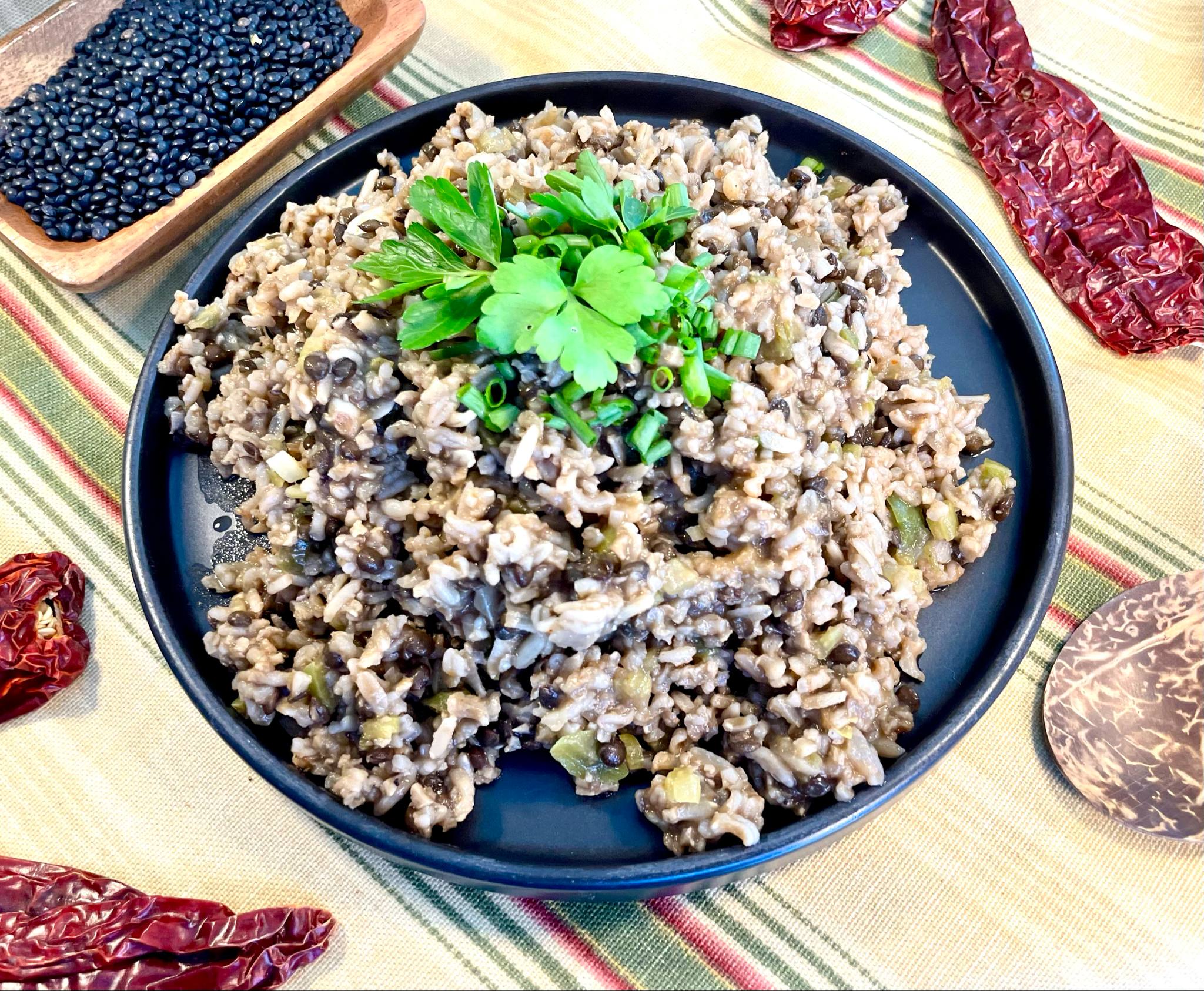
This protein-packed veganized version of the Louisiana Creole classic is more satisfying than your average side dish. Black lentils create a visually appealing color contrast while contributing to the meat-like texture, while onions, celery and green bell pepper, a.k.a. the cajun holy trinity, anchor the flavor profile.
WHY BLACK LENTILS
Before I start waxing on about what I love about black lentils, let me just say that this dish would also work with green or brown lentils, so you don’t have to go out of your way to get black lentils unless you feel like it. If you do want to try black lentils, I recommend ordering them from Rancho Gordo.
Like just about everyone who follows a whole food plant-based lifestyle, I eat a lot of beans and I want as much variety as possible. That’s what got me to try black lentils in the first place. Also called beluga lentils, or caviar lentils, because of how they look before they’re cooked, these beans are versatile and convenient. Like all other lentils, they cook quickly without having to be soaked. Unlike other lentils, they’re shaped more like puffy little pillows than like saucers. When cooked, they lose some of the blackness, becoming more of a dark grayish brown. Compared to other lentils I’ve prepared, black lentils are denser after they’re cooked, less mushy. The density is great for some recipes, but may not be desirable for others. The taste is subtle, slightly nutty. Mostly I like the texture and how they look against rice. They need about the same cooking time as brown rice. So a lot of times, if I’m making brown rice, I’ll throw in a handful of black lentils. They make my rice more interesting and I’m getting more pulses, a win-win. For a more comprehensive discussion, check out my ingredient spotlight post on black lentils.


In this recipe, I cook the rice together with the black lentils. Cooking them together makes the dirty rice look dirtier as some of the pigment from the lentils transfers onto the rice, but there’s still enough color left on the lentils to create a visually appealing contrast in the final product.
TEXTURIZED VEGETABLE PROTEIN (TVP)
Texturized vegetable protein, or TVP, has been around since the 1960s and in my opinion, when you consider nutritional profile and cost as well as convenience, there’s no better plant-based ground beef alternative for recipes where the ground beef substitute doesn’t have to form a ball or a patty. In other words, I love TVP for things like chili, tacos, and lasagna, but it’s not great for veggie burgers or meatballs. TVP is a good source of protein and fiber while being sustainable and easily accessible. And because TVP is a fully dehydrated soy product it has a very long shelf life. Although whole food plant-based is mostly about avoiding processed foods, TVP is one of a handful of processed foods recommended for people who are WFPB adherent.
My research into traditional omnivorous dirty rice recipes revealed that, although many different types of meats can be used to make dirty rice, usually more than one meat is used in a recipe. I found that ground pork was one of the most popular ingredients. Since hydrated TVP is similar in color and texture to cooked ground pork, I thought it would pair well with the more mealy texture of the black lentils.
Most recipes will have you soak your TVP in some sort of liquid for a few minutes before incorporating it into a recipe. In its dry form, TVP looks sort of like Grape Nuts cereal (see second photo below). After it soaks for a few minutes, it resembles cooked ground turkey or pork. For this recipe I use vegan “beef” flavored bouillon cubes to create a broth that imparts a meaty umami flavor. I use part of that broth to pre-soak my TVP. I’m sure that other types of vegan broth would also work in this recipe.


TOMATO POWDER OR PASTE
A new-to-me ingredient I’ve come to love is tomato powder which is tomato paste in a dry powdery form that can be stored in your pantry almost indefinitely. There is a subtle but distinct umami quality to the flavor. Tomato powder contributes a note of tang that is less recognizably tomato-y than tomato paste. Aside from enjoying the convenience, I prefer the more subtle flavor profile of tomato powder in many of my recipes. You can substitute tomato paste for by doubling the volume: 1 teaspoon tomato powder = 2 teaspoons tomato paste.
To learn more about tomato powder check out my tomato powder ingredient spotlight post.

SHIITAKE MUSHROOM POWDER
I would be in mad love with shiitake mushroom powder even if it wasn’t as ridiculously good for you as the research says it is. Think vitamins, minerals, immune function, weight loss and more. You can google the scientific good-for-you part, if you’re interested. After all, this is a recipe post, not a research paper for a plant medicine class, and I’ve been known to geek out a tad too much.
Mushrooms in general contribute a depth of umami flavor that we usually associate with animal foods. I love cooking with fresh and dried mushrooms. I’m even a fairly skilled mushroom hunter. But it’s often the case that I want to bring some of that umami mushroom goodness into my cooking without introducing the texture of a mushroom. And that’s where culinary mushroom powders come in. Almost any culinary mushroom powder would be good in this recipe, shiitake mushroom powder just happens to be my personal favorite. Porcini powder and lion’s mane powder are also amazing. It’s worth investing in mushroom powders as pantry staples. Using them sparingly, adding little bits here and there in your cooking, can really take savory vegan dishes to another level.

OIL-FREE SAUTÉING
It took a while for me to embrace the idea that you can sauté your food without using any oil. Even when I was already completely on board with the whole food plant-based lifestyle philosophy, I felt like being 100% oil-free was for people who had non-stick pans, not for someone like me who prefers cast iron skillets and ceramic pots. So for a long time I kept using little bits of oil at the beginning of my sautéing process and then adding small amounts of water when things began to stick. I still use this hybrid method for some things, but I’m realizing that that little bit of oil at the beginning is usually not necessary at all. In fact, if you want a teaspoon or two of oil because you love the flavor of certain oils (think extra virgin olive oil or toasted sesame oil), you’ll get much more from your oil if you use it as a finishing oil in the final step of the recipe than at the beginning when you’re heating it up. But I digress.
In this recipe, the oil-free sautéing method works beautifully. As you use the stock to sauté your ingredients, you’re also creating a reduction of the stock that intensifies the flavor of the dish. You’ll start with 1-1/3 cup of stock that you have to use up in cooking the veggies, pre-soaked TVP and spices. That’s a lot of stock, and needing to use it up forces you to take your time to really soften the vegetables, layering the flavors. The end result should be wet but not soupy. In the final step you’ll add the cooked rice and lentils along with the green onions and parsley to the sautéd ingredients.


DON’T SKIP GREEN ONIONS AND PARSLEY
In this recipe, the green onions and parsley are not just garnishes. They are an important part of the flavor, texture and appearance of the dish. Let’s face it, by veganizing this exceedingly meat-centric traditional dish and using beans, we’ve already taken things in a radically different direction. I think it’s important to include as many of the already vegan components in classic versions in order to stay as true to the spirit of the original.
related recipes you’ll love


Vegan Dirty Rice with Black Beluga Lentils and TVP WFPB Oil-Free

Equipment
- small cooking pot
- Medium Cooking Pot (or large skillet)
- small bowl
Ingredients
- 2 cubes vegan 'beef' bouillon (sub with vegetable or vegan 'chicken' bouillon)
- 1 cup brown rice (I use brown basmati)
- ⅓ cup dry black lentils, rinsed and picked through (brown or green lentils also work)
- ⅓ cup texturized vegetable protein (TVP)
- 2 tablespoons minced fresh garlic
- ½ cup onions, finely chopped
- ½ cup green bell pepper, finely chopped
- ½ cup celery, finely chopped
- 2 teaspoons Cajun seasoning mix
- 2 teaspoons Shiitake mushroom powder
- 1 teaspoon tomato powder* (or 2 teaspoons of tomato paste)
- 3 tablespoons fresh parsley, chopped
- 3 tablespoons green onions, finely chopped
- salt and black pepper to toaste (optional)
Instructions
- Place one of the bouillon cubes and 3-1/2 cups of water in a small pot and bring to a boil over high heat. Add brown rice and lentils to the pot. Reduce heat to low. Cover and simmer for 30 minutes until rice and lentils are fully cooked. If there's extra liquid, don't strain it away, just leave the pot covered. This step can be done way ahead of time, or while you're preparing your other ingredients.
- Place the other bouillon cube in a small bowl or large measuring cup that holds at least two cups of water. A large pyrex measuring cup with a spout is perfect for this. Pour two cups of hot water over the bouillon cube and dissolve to create a stock.
- Place TVP in a small bowl, then pour about 2/3 cup of the stock you created over TVP and set aside.
- Pour about 1/4 of your remaining stock into a medium sized pot or large skillet and bring to a boil over high heat keeping the remaining stock close at hand.When the stock starts to boil, bring the heat down medium-high and add the onions, green bell pepper, celery and garlic to the pot. Sauté for 8 to 10 minutes adding small amounts of stock every minute or two to keep vegetables from burning or sticking as stock boils down. Do this until the onions are translucent.Add the pre-soaked TVP to the sautéd veggies, mix and keep cooking for three more minutes, adding more broth a little at a time.Now add Cajun seasoning, mushroom powder, and tomato powder (or paste). Continue to sauté, adding stock a little at a time until you've used up all of your stock. Be patient, you're creating fabulous layered flavor. Stop sautéing and turn off heat when your mixture looks like a thick sauce. It should be wet but not soupy.
- Add parsley, green onions and cooked rice and lentils to your seasoned veggie and TVP mix and blend. You may need to heat up your dirty rice a bit, especially if your rice and lentils are not piping hot.
- Taste before deciding if you need to use salt and pepper. You may also want to add a little more Cajun seasoning.
- Serve hot!



Leave a Reply